Friday, January 5, 2018

"Mercy bend and bring me back to life"

Today was longer and a bit more challenging than anticipated. Nonetheless, I want to post a traditio for the first Friday of the New Year. Because it's been awhile, there were a lot of options running through my mind as I pondered what to post. Then, on the way to the Funeral Vigil for a dear friend who passed away from cancer on the second of this New Year, I listened to my CD of Audrey Assad's album The House You're Building.

Assad's album is wonderful. I hadn't listened to it in awhile. I put my car CD-player (yes- I still have a car CD-player) on that random mode so the songs did not play in order. After a couple of songs, it went to the eleventh and final track on the album: "Show Me."


I mentioned in my New Year's post that the last couple of years have been kind of tough going. It's alright for life to be difficult. It is okay to admit that sometimes I find life difficult. Nobody needs to fix that or attempt to fix it. My hope is in Christ. A finite world will never satisfy a heart that yearns for the infinite.

Anyway, "Show Me" captures well, in the way that poetry and songs, or the poetry of songs, what I am trying to say. Oddly, it makes my heart glad that this is the first traditio:


The chorus of the song is simply lovely:

Bind up these broken bones
Mercy bend and bring me back to life
But not before you show me how to die

Wednesday, January 3, 2018

Cultivating Inner Peace

"The passionate man often thinks evil of a good man and easily believes the worst; a good and peaceful man turns all things to good.

"A man who lives at peace suspects no one. But a man who is tense and agitated by evil is troubled with all kinds of suspicions; he is never at peace with himself, nor does he permit others to be at peace.

"He often speaks when he should be silent, and he fails to say what would be truly useful. He is well aware of the obligations of others but neglects his own . . .

"You are good at excusing and justifying your own deeds, and yet you will not listen to the excuses of others. It would be more just to accuse yourself and to excuse your brother.

"If you wish others to put up with you, first you must put up with them."


Thomas á Kempis, The Imitation of Christ (Book II, cap 2-3).

It is my prayer that these words speak as clearly to somebody else today as they have to me.

Monday, January 1, 2018

Happy New Year

Today, 1 January, Roman Catholics the world over celebrate the Solemnity of Mary, the Mother of God. Additionally, for the fifty-first year, Catholics also observe the World Day of Peace.

Despite 2017 being a light year for blogging, I ended the year in a flurry of activity. As a dedicated Catholic blogger, I felt not posting something on New Year's day would be too much of an oversight. Despite not having anything really profound to convey in this post, I wanted to say to both my readers, Happy New Year!

I don't mind admitting that the past two years have been a little difficult for me. I often reflect on how easy it is to convey a false image online. But I assure you, my life is filled with its challenges, failures, disappointments, arguments, and frustrations. I often grow frustrated with others, with circumstances, and, most of all, with myself. I also must admit that I find maintaining this weblog quite therapeutic. So much so that I would say this past year would've been easier had I taken more to time to reflect on things the way this blog causes me to reflect, which is by helping me to see the bigger picture. I hope that by trying to see and write about the bigger picture without losing touch with reality you find reading what I have to write helpful. I would be the first to say, don't feel obligated to spend time here. Time is the currency of existence spend it wisely. Whether you read what I write or not my pay ($0) remains the same.

In order to have more peace in my life and to enhance the quality of my life, 2018 is the year I am going to significantly alter my relationship to the digital, or cyber, world. Besides having a lot to do, I just want to be happier and less encumbered by the constant assault of social media. What this will entail remains to be seen. I am planning how to manage things. Most of all, I need to spend more time in silence and more time praying. This is not a matter of getting back to any period of time during which I felt closer to the Lord, but a matter of moving forward.


It is easy in our current circumstances to see nothing but dark clouds gathering over the world. In his Urbi et orbi Christmas message, Pope Francis noted that "the winds of war are blowing in our world." Being less connected online is not an attempt to ignore reality. Rather, I want to connect more deeply. In the words of the song, "Let there be peace on earth and let it begin with me." For peace to begin with me, peace must begin within me. I need to be more at peace in order to live more peaceably with others and be a force for peace in the world, in my community, in my workplace, in my parish, and in my family.

All of this makes me chuckle a bit because writing about it makes it seem so easy. Paradoxically, peace requires a struggle. 2018 is a year for me to really engage in that struggle. One of the means I will use to engage in the struggle for peace is the Most Holy Rosary of the Blessed Virgin Mary. I pray the Rosary now almost daily. But I usually pray it on-the-go, not meditatively. Among my goals is to pray the Rosary in a meditative manner at least a few times a week. There are other contemplative practices I need to either resume or begin.

In any case, I do not plan to stop posting here. On the contrary, I plan to continue because blogging, believe it or not, is a source of peace for me. How regularly, as I mentioned yesterday, remains to be seen. One Rosary intention for the New Year is for everyone who reads this blog- that they may be blessed by so doing. Whether being blessed by reading what I post means being consoled, encouraged, or challenged I leave up to the Holy Spirit.

May the peace of God, through the intercession of the Blessed Virgin Mary, be with you as you embark upon this New Year.

Sunday, December 31, 2017

Καθολικός διάκονος: End of the year roundup

It's time to wrap up another year of blogging here at Καθολικός διάκονος. 2017 marked twelve years since I started this blog and 11 years of regular blogging. Posting a mere 116 times makes this year the sparest year since I began blogging in earnest way back in 2006. Nonetheless, I look forward to blogging in the new year. How much I will be able to do so remains to be seen.

It is a tradition for me to select a post from each month of the past year that I think is worthy of mention at the end of the year. Below you will find a pick for "post of the month" for each month of 2017. I would be happy to have both my readers share their post or posts from the past year from this blog.

Serving with my bishop, Oscar Solis, and pastor, Fr. Rene at this year's Confirmation Mass (I am on the left)


January- "We desire not only to know fully but to be fully known"

February- "Scripture, revelation- apprehending and living the truth"

March- "'Those who find themselves ridiculous'"

April- "Degenerate language; degenerating faith"

May- "A Sunday to consider deacons"

June- "Tobit and the importance of burying the dead"

July- "The war I must wage: destroying a piece of my own heart"

August- "Liturgy and the totus Christus"

September- St. Thérèse on love and unbelief

October- "On the Reformation"

November- "A deacon on a layman about deacons"

December- The Shroud of Turin: Short Take

Happy New Year to everyone who reads this. I pray God's blessing upon on you no matter who you are or how you arrived here.

Saturday, December 30, 2017

Belonging to God's Holy Family

Reading: Hebrews 11:8.11-12.17-19

For today's Feast of the Holy Family, the Church provides us with a number of readings, each one worthy of being read, meditated upon, and contemplated. Because, apart from the Gospel of Luke and the Acts of the Apostles, which is the second volume of Luke' Gospel, often referred to (rightly, in my view) as "the Gospel of the Holy Spirit," my favorite book of the New Testament is the anonymously-composed Letter to the Hebrews, I am going to go with the option from the eleventh chapter of Hebrews (Wow! What a long sentence!). One reason for choosing this, apart from being so enamored with Hebrews, is this year, it seems, God has laid it on my heart to move past the sentimentalism that is so bound up with Christmas. While not entirely bad, such sentimentalism can impede discipleship, thus inhibiting the Church's mission. This discernment was borne out when I read Pope Francis's Christmas Urbi et orbi message.

It seems to me that the dominant theme in this reading is Abraham's willingness to sacrifice everything for God. Of course, God the Father sacrificed everything for us, namely his Son.

In Pope Francis's too easily forgotten first encyclical letter on the theological virtue of faith, Lumen Fidei, which was largely composed by Pope Benedict XVI, thus completing his cycle of encyclicals on the theological virtues: Love = Deus Caritas Est; Hope = Spe salvi, in a portion entitled "Abraham, our father in faith," we read: "Abraham is asked to entrust himself to this [God's] word. Faith understands that something so apparently ephemeral and fleeting as a word, when spoken by the God who is fidelity, becomes absolutely certain and unshakable, guaranteeing the continuity of our journey through history. Faith accepts this word as a solid rock upon which we can build, a straight highway on which we can travel" (sec. 10).

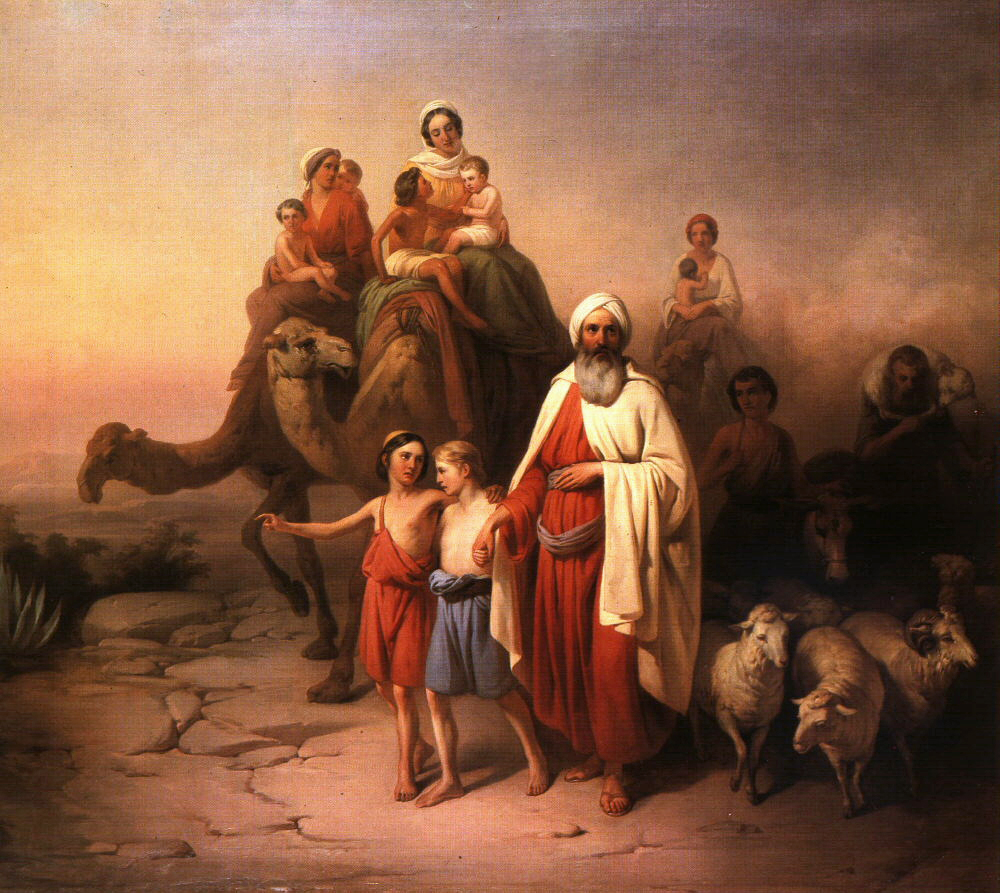
Abraham left his home in Ur of the Chaldees because he trusted God's promise that there was a land prepared for him and his descendants to inhabit perpetually. When he left home, Abraham had no idea where this land was, which meant he had no clue as to how long his journey would be or where it would end. Trusting God, he packed up his family and belongings and headed out.

Abraham's Journey from Ur to Canaan, by József Molnár, 1850


God promised Abraham descendants who would be as numerous as the sands of the seashore. Yet, he had only one child with his wife Sarah: Isaac and, at Sarah's insistent urging, another one with Hagar, Sarah's servant: Ishmael. As St. Paul noted: "For it is written that Abraham had two sons, one by the bondwoman and one by the free woman" (Gal 4:22).

It is by faith that we, too, are Abraham's children. This is how God fulfilled his promise: "there came forth from one man, himself as good as dead, descendants as numerous as the stars in the sky and as countless as the sands on the seashore" (Heb 11:12). St. Paul, in his Letter to the Galatians, wrote: "But when the fullness of time had come, God sent his Son, born of a woman, born under the law, to ransom those under the law, so that we might receive adoption proof that you are children, God sent the spirit of his Son into our hearts, crying out, 'Abba, Father!' So you are no longer a slave but a child, and if a child then also an heir, through God" (Gal 4:4-7).

We have trusted God's promise, sealed by the death and resurrection of his Son. This is precisely the promise that Anna and Simeon recognized when they encountered the child in the Temple. This trust, which is better-labeled hope and is the flower of faith, is wrought by the power of the Holy Spirit of the Father and the Son. It is by being born of the Spirit that we become God's children, members of God's Holy Family.

Being born of the Spirit, something Jesus taught us must happen (see John 3:5-8), is how we become children of God, making us members of his family, the Church. Belonging to God's family means that, like Abraham, our father in faith, we too, are pilgrims, "Hebrews," which means foreigners, making our pilgrim way to God's holy city. Like Abraham, we are called upon to make sacrifices, perhaps to sacrifice everything that, to borrow more words from St. Paul: "forgetting what lies behind but straining forward to what lies ahead, I continue my pursuit toward the goal, the prize of God’s upward calling, in Christ Jesus" (Phil 3:13-14).

Our pilgrimage, our journey through time, continues apace into the New Year. It is easy enough to know where God is leading you, at least ultimately. What is not so clear is the route you God will have you take. Hence, it is not so important to know where God is leading you in the new year. What remains important is that, like Abraham, you trust God to fulfill his promise. Given his deep Christian faith, I think this strikes pretty close to what Tolkien meant when he wrote, "Not all who wander are lost."

Because we belong to God's Holy Family by virtue of being reborn of the Spirit, we journey together, as companions. We are companions because we share the Bread that sustains us on our pilgrim way. As Michael Card sang, "There Is A Joy In the Journey."

Friday, December 29, 2017

Russell Brand, learning and growing

This morning an online friend, who is a priest in the Church of England, brought to my attention an article in Relevant magazine about British comedian Russell Brand: "The Second Coming of Russell Brand: Fifteen years after embracing sobriety, he’s now talking about how culture can stop its destructive patterns: by following Jesus." At the beginning of the piece Brand is quoted as saying, "My personal feeling is the teachings of Christ are more relevant now than they’ve ever been." The article is a rather lengthy interview with Brand about his nascent Christianity, if I may state it that boldly. which is probably too boldly.

I will be honest, until a few years ago I really couldn't stand Russell Brand. But it's clear that he has become a more mature human being. As a 52-year-old emotionally going on something like 22 myself, it's nice to see someone else growing up, learning and changing. He makes ample use of Chesterton's observation that every man who knocks on the door of a brothel is looking for God. This expresses the human condition in a rather pithy manner, even if from a male perspective.

Even though I have come think better of Brand prior to reading the Relevant piece, reading it surprised me. I have friends who are successfully recovering from addiction and who did not find the 12 Step AA model helpful. That is fine. The 12 Steps are so widely used and often people go against their will, which most of the time is a waste of time, that its lack of success in terms of the percentage of people who achieve long-term sobriety doesn't appear promising. Like any other behavioral therapy program, there is no magic in the 12 Steps apart from doing them with the help of a supportive group of people. But like all people who struggle with addiction, friends who did not find AA helpful have no problem with the program insofar that it does help people achieve and maintain sobriety.

Russell Brand


Heaven knows that in this age of our rapidly growing knowledge of the human brain AA often looks very outdated. AA looks even worse when it becomes completely disconnected from its spiritual roots, which are Christian. Pastorally, my work with people in recovery has been with people who are achieving sobriety for the third or fourth time and, as a result of finding themselves back where they started, have grasped that the spiritual component of recovery, which is but one dimension and not the whole thing, is something to which they need to attend. It is for this purpose that I will keep and use Brand's Relevant article.

Brand, in an unassuming way, really provides a wonderful lesson in what it means to pray: "I say the Lord’s Prayer every day. I try to connect to what those words mean. I connect to what the Father means. I connect to what wholeness means to me. I think about the relationship between forgiveness and being forgiven and the impossibility of redemption until you are willing to forgive and let go." What do the words we pray mean? This is a question we should constantly ask ourselves.

Indeed, it is in the spiritual roots of the 12 Steps that Brand finds strength (comedian Marc Maron, who is Jewish, similarly discusses the importance of prayer for his own recovery). Brand, using the Lord's Prayer, which Guardini though of as a Catechism, has kept following the road, moving beyond his dependence on drugs, sex, and alcohol to dependence on God:
I’ve seen in many formats now—because I’ve played out the same pattern many times—the attachment to physical things, physical behaviors or people, will never make me happy,” he explains. “But service of others and values that are certainly found in Christianity will make me feel peace or make me feel happy. It’s a lesson that’s very hard to learn
As Keith, who brought this to my attention, noted: by being as transparently honest as he is this piece Brand has likely set himself up for some public ridicule in highly secular England. All I can say is, "Good for him."

Evangelizing culture in the digital age

This week's Friday traditio, the last of this seminal feature of Καθολικός διάκονος that has been infrequent this year, was made easy by an amazing article written Nick Ripatrazone for America magazine: "A Catholic Media Trinity: Marshall McLuhan, Walter Ong and Andy Warhol." While short, there is a lot to be ingested from this piece, which summarizes the approach of three prophets of our digital age, all whom "watched the electronic age arrive and did not blink."

Evangelization is a word Catholics use these daze ad nausaum. "Evangelization" is often used synonymously with "apologetics." But apologetics, which has its place in evangelization, albeit a very confined and small place, is very often the case of offering a discourse in the face of life's inescapable questions, those questions about purpose and meaning that make us human. By "offering a discourse" I mean answering questions nobody is asking in a boring, didactic manner.

Marshall McLuhan, a devout Catholic convert, whose work is as fresh today, perhaps even fresher, than when he wrote it, grasped what it means to evangelize in the digital age (something I hope I do in these poor web pages that constitute my blog): "We must confront the secular in its most confident manifestations, and, with its own terms and postulates, to shock it into awareness of its confusion, its illiteracy, and the terrifying drift of its logic. There is no need to mention Christianity. It is enough that it be known that the operator is a Christian."

It's no good trying to roll back the tidal wave of history. Nonetheless, some try. All such efforts are bound to fail. History, as the Church historian Angelo Roncalli, speaking as Pope John XXIII at the opening of the Second Vatican Ecumenical Council, is "the great teacher of life." The lowest ebbs of ecclesial history are when the Church misconceived the Gospel of Jesus Christ as a rearguard action. Such a misconception fails to recognize, let alone realize, that Christ is the Lord of history and that both presently and in the end, all history is salvation history. There is no human milieu in which God, through Christ and by the power of the Holy Spirit is not active and present.

Marshall McLuhan


According to Riptrazone, Andy Warhol is a great example of evangelization as set forth by McLuhan:
High and low, sacred and mundane, immediate and eternal: Paradox is endemic to Catholic storytelling and art. Warhol was one of its finest visual prophets. At Warhol’s memorial service, the art historian John Richardson pulled back the veil: Warhol was a devout Catholic, and his faith was "the key to the artist’s psyche." He went to daily Mass at the Church of St. Vincent Ferrer in New York and served meals to the homeless. "Never take Andy at face value," Richardson explained. "The callous observer was in fact a recording angel" Ripatrazone
Our Friday traditio for this last Friday of 2017 is a song by Lou Reed and John Cale of the Velvet Underground, a band that owed a lot to Warhol. The song, entitled "Work," is off a memorial album for Warhol Reed and Cale cut called Songs for Drella:

Andy was a Catholic,
the ethic ran through his bones
He lived alone with his mother, collecting gossip and toys
Every Sunday when he went to church
He’d kneel in his pew and say, ‘It’s just work, all that matters is work'

Tragedy challenges God's love

No sooner did I finish my reflection on this week's second reading from Romans chapter 8 about the all-encompassing nature of God's...