Monday, December 17, 2018

Updated reporting on clerical sexual abuse

Back in August I posted on how my diocese, the Diocese of Salt Lake City, responded after the U.S. Bishops approved the so-called Dallas Charter (see "Holy Mary, Mother of God, pray for us sinners now...") back in 2002. In a report publicly released on 14 June 2002, our then-bishop, George Niederauer, who went on to become archbishop of San Francisco a few years later, divulged the number of clergy (all of whom were priests), going back to 1950, who had credibly been accused of sexual abuse: 13 in total. In the report he also gave the number of reported incidents: 18. Additionally, he provided information about what the diocese had paid out to that point to victims: $58,000 in total, $43,000 for pastoral outreach, $15,000 on legal fees, and $0 in settlements. $20,000 of the cost of pastoral outreach was covered by insurance. Then-Bishop Niederauer did not divulge the names of abusive clerics, where they served, what happened as a result of their being credibly accused, or their current status. Neither did he reveal the nature of any of the credible allegations.

Today, the current bishop of Salt Lake City, Oscar Solis, released a statement and, more importantly, a detailed spreadsheet that provides the names of priests against whom credible accusations have been made, along with other information concerning the allegations.

By my count, since 14 June 2002, twenty more allegations have come to light. Considering one allegation, alleged to have occurred earlier this year, was dismissed by the Utah Division of Child and Family Services (DCFS), the number of credible allegations released today can be numbered at 19. Seventeen of the of these additional credible incidents are attributable to twelve priests. One allegation is against a religious brother who belonged to the Oblates of St. Francis de Sales and one was made against a seminarian. Of the twelve priests, three had been credibly accused of at least one incident of sexual abuse prior to the June 2002 report.

As noted, the 2002 report gives as 13 the number of priests with at least one credible allegation of sexual abuse. The spreadsheet put out today includes nineteen names. As I pointed out above, two of those who appear on the spreadsheet were not priests. This leaves 17 priests who, since 1950, have at least one credible allegation of sexual abuse against them, according to today's disclosure. Judging by the dates given as to when the diocese learned of the allegations, there were credible allegations against 9 priests that the diocese did not receive until after the release of the June 2002 report. For example, one incident, involving Paul Franco, was reported to the diocese on 17 June 2002, just three days after the diocese's initial report.

Coat of arms of the Diocese of Salt Lake City


Comparing today's report to the 2002 report, the number of priests who have served in the diocese since 1950 and who have credible allegations of sexual abuse against them should go up from thirteen to twenty-two. But today's accounting lists only 17. I realize these things can be trickier than many people assume and that there may be some older instances for which complete information is not available, but it seems to me there is a difference of 5 priests between the 2002 report and today's disclosure. Perhaps it is a case of a few dates entered erroneously. In any case, I laud the transparency of today's data release. I am very pleased at detailed information provided. I have no doubt about my diocese's commitment to safeguarding young people and vulnerable adults.

According to the 2002 report, from 1950 to 2002 a total of 476 priests had served in the Diocese of Salt Lake City. The number of priests who have served in our diocese has increased in the past 16 years. I do not know by how many. Judging from some of the questions I received after my post last August, the most valuable information on the spreadsheet consists of the current status of these men, what actions were taken in light of the credible allegations against them, and where each one served and the years in which they served in each place.

Seven of the seventeen priests on the list are now deceased, as is the religious brother. It appears six of the eleven who are still alive were removed from the clerical state, five forcibly and two voluntarily by leaving the priesthood. One of those forcibly removed from the clerical state, James Rapp, is incarcerated in Oklahoma. Four men were retired from ministry and had their faculties to minister as priests removed. In this latter category is David Gaeta. In August of this year he was credibly accused of two instances of sexual abuse that are alleged to have occurred in Ogden in 1982. His retirement and the removal of faculties was announced today by Bishop Solis. According to the bishop's statement, "Removal of faculties means the individual may no longer engage in public ministry, including dressing as a priest, presenting himself as a priest in good standing, performing public Masses, hearing Confessions, or conducting Baptisms, Marriages, or administering other Sacraments." The seminarian against whom there is a credible allegation of sexual abuse has long since been dismissed.

Looking at the two publicly available reports, it would appear that the total number of incidents reported since 14 June 2002 is one more than double of the number previously reported. But instead of 37 incidents (18 + 19= 37), the report released today includes 29 credible allegations (30-1; the one being the allegation dismissed by the DCFS). Not dismissing the difficulty of this kind of accounting and reporting, I think this represents progress. Looking at the dates on which the additional nineteen sexual abuse incidents are reported to have taken place, 2 of those have occurred since June 2002. One of those is the incident involving the now-dismissed seminarian and that happened in 2002. The other credible report was from 2003. There were no updates on any financial pay-outs the diocese may have made since 2002.

It also bears noting that one priest of the diocese is currently suspended pending the diocese's determination in the wake of pleading no contest to a charge for soliciting prostitution (see "Priest of Salt Lake Catholic church charged with soliciting prostitution").

Sunday, December 16, 2018

Year C Third Sunday of Advent

Readings: Zeph 3:14-18a; Isa 12:2-; Phil 4:4-7; Luke 3:10-18

Today, Roman Catholics along with many other Christians, celebrate Gaudete Sunday. In practical terms, this means today is the day we light the rose-colored candle. Why is it called Gaudete Sunday, you might ask? We call today Gaudete Sunday because Gaudete, which is Latin for “Rejoice,” is the first word of the Introit for today’s Mass. Your next question is probably, “What is an Introit?”

The word Introit is Latin. It is a combination of intro-, “to enter into,” and the Latin root word, ire, a verb meaning “to go,” “to take action.” So, the Introit means entering into an action, to start something. Think of it like the overture of a symphony, in which the all the musical themes taken up by the composer in the various movements that comprise the work are introduced.

When considering the purpose of the Introit, it is most useful to keep in mind that the word “liturgy,” which is of Greek origin, refers to the work of the people as well as work done on behalf of the people. The suffix of “liturgy,” -urgy, from whence we derive our word “urge,” refers to a deliberate action, or work. To engage in liturgy, then, means to take part in and/or be the recipient of a deliberate and beneficial effort. The work in which we engage in liturgy is not only directed to a specific end but is the primary means through which God seeks to complete creation.

A bit more down-to-earth, the Introit is a short verse that sets the tone or lays out the themes of the liturgy for a given eucharistic celebration. Our parish, like the vast majority of parishes these days, does not sing nor does the priest recite the Introit at the foot of the altar. A few churches, churches, like our Cathedral, still sing it each week.

The Introit for Mass for the Third Sunday of Advent is taken from our epistle reading, which is a passage from St. Paul’s Letter to the Philippians: “Rejoice in the Lord always; again, I say rejoice. Indeed, the Lord is near.” Or, in Latin: Gaudete in Domino semper: iterum dico, Gaudete. Dominus enim prope est.

It is vitally important that the work in which we engage during the liturgy extend beyond the end of Mass. Hence, it is highly relevant to note that our term “Mass,” from the Latin missa, refers to our being dismissed when it ends. Missa, in turn, is related to missio from whence we derive the word “mission.” It does not mean to be “dismissed” in the pejorative sense. Rather, it means being sent. This is what makes the Church, makes us, apostolic; we are those whom the Lord sends to make him present wherever we are.

Every year, the Gospel reading for the Third Sunday of Advent is about the mission of John the Baptist. Among Western Christians, the Baptist’s prominence has faded quite a bit over the centuries. Like the Blessed Virgin Mary, the Baptist plays a singular role in God's economy of salvation. It is difficult to exaggerate the importance of his one-of-a-kind ministry. He was not only or even primarily the last of the Old Testament prophets. He was the one uniquely chosen by God to be the herald, the forerunner of the Messiah. St. Luke even tells us that while the Baptist was still in the womb of his mother, Elizabeth, he was filled with the Holy Spirit and leaped at the approach of the Messiah, who was still in Mary’s womb (Luke 1:39-45). The final chapter of the Book of the Prophet Malachi, which is the final book of the Old Testament contains a prophecy:
Now I am sending to you Elijah the prophet, Before the day of the LORD comes, the great and terrible day; He will turn the heart of fathers to their sons, and the heart of sons to their fathers (Mal 3:23-24)


Speaking of the Baptist, Jesus himself said:
among those born of women there has been none greater than John the Baptist… All the prophets and the law prophesied up to the time of John. And if you are willing to accept it, he is Elijah, the one who is to come (Matt 11:11.13-15)
Of course, Elijah, who was taken up into heaven in a chariot of fire (see 2 Kings 2:8-14), was greatest of the strictly Old Testament prophets.

I admit that what I have said so far might be dismissed as academic; “Interesting, but so what?” This brings us to the question that constitutes the heart of today’s readings, especially our Gospel text: “What then should we do?” (Luke 3:10). The “crowds” asked this question after the Baptist, who began by denouncing them as a “brood of vipers,” challenged them to repent and “Produce good fruits as evidence of [their] repentance,” lest they “be cut down and thrown into the fire” (See Luke 3:7-9).

Hearkening back to extending our work of liturgy beyond the Mass, it is useful to note that the crowds do not ask the Baptist “What shall we believe?” They certainly did not pose the question that in all honesty we are sometimes tempted to ask: “How shall we interpret John’s words in such a way that we may maintain our comfort while our neighbors suffer?” (See Austin Crenshaw Shelley, “December 16, Advent 3C, (Luke 3:7-18)”). As Austin Shelley pointed out, the Baptist’s reply to the question of the crowds could not be clearer: “Repentance has to do with ethics, with action, with the Holy Spirit’s compelling us to be God’s hands and feet in the world—with attention to the needs of others rather than preoccupation with our own salvation” (Ibid).

In our reading from Paul’s Letter to the Philippians, in which he urges them to rejoice always, the apostle points to one sure source of joy, and so of rejoicing: “Your kindness should be known to all” (Phil 4:5a). The Greek word translated into English as “kindness” is epieikés. Literally, epieikés means “true equity,” or “true justice.” In other words, Paul is urging them to be heralds of Christ by enacting “justice beyond ordinary justice.” I can only conceive of justice beyond ordinary justice as mercy and compassion.

The psychological distress of American #Christmas,” tweeted the satirical but often insightful Werner Twertzog last week, “is the result of unsustainable cognitive dissonance regarding its overt claims and its covert purposes” (See Werner Twertzog, 14 December 2018. 8:18 AM). In other words, there often seems to be a disconnection between who we celebrate and how we go about celebrating. Our giving in to the temptation to leap over Advent in our rush to Christmas is one sure sign of this disconnection.

The people asked the prophet, “What shall we do?” It’s easy to imagine the answer is complicated. But in this instance, the answer is quite straightforward. Consider the Baptist’s first response, which applies to everyone and not only to unique situations he addresses with regard to tax collectors and soldiers, whose interest in his message serves to highlight the power of John’s preaching: “Whoever has two tunics should share with the person who has none. And whoever has food should do likewise” (Luke 3:11). These are the works in which, as disciples of the One whose herald the Baptist was and whose heralds we are called to be by virtue of our Baptism, we should be engaged. Such works are the fruits produced by anyone who is genuinely repentant. It is by engaging in these works that we extend the liturgy. By going forth to make Christ present to those with whom we find ourselves, especially helping those in need, they can rejoice that the Lord is near.

Friday, December 14, 2018

"Well that’s how broken I would be"

I don't know about you, but despite my best efforts over the past several years, Advent is just a busy time. This year, I don't mind admitting, Advent, at least thus far, has been downright hectic. On the First Monday of Advent I was hit by a pick-up truck with a snowplow on the front of it while driving to work. The driver of the truck ran a red light and t-boned me. Somewhat surprisingly, I walked away from the crash uninjured. My car, however, was totaled. For the past 12 days, I have been driving a rental car paid for by my insurance company. But now the settlement for the totaled car has been figured and I have to turn the rental back in tomorrow. This is means I have to buy a car today or tomorrow. We have only gone looking at cars once, a few hours last Saturday. Of course, this comes on top of everything else. While I am prone to complaining, I really shouldn't. I don't have much to complain about.

Looking back over the past year, I can honestly say that I am not sure I could survive another year as physically and emotionally draining as 2018. Someone once quipped that in the middle everything feels like a failure. Being middle-aged, at least for me, takes that observation to a whole new level. Stated another way, I have gained a lot of humility since turning 50 a little more than three years ago. I am not at a point, even yet, where I think of myself as old. I am starkly conscious that I am no longer young. It's a strange place, a vulnerable place.

In light of the above, it is fitting that the Old Testament canticle, included in the Psalmody for Friday Morning Prayer, Week II of the Psalter, is taken from the Book of the Prophet Habakkuk. The canticle includes this:
For though the fig tree does not blossom, and no fruit appears on the vine, Though the yield of the olive fails and the terraces produce no nourishment, Though the flocks disappear from the fold and there is no herd in the stalls, Yet I will rejoice in the LORD and exult in my saving God (Hab 3:17-18)


Last night driving home from my office pre-Christmas party I was regaling my lovely wife with songs I like as she drove us home. I played Morrissey, The Pretenders, The Smiths, The Cure, Joy Division, and New Order. My wife, for those who don't know, is a classically-trained pianist and music theorist. She mostly tolerates my music and even finds it amusing at times. Last year, the week after my birthday, she accompanied me to see Morrissey live in concert. After listening to 3 or 4 songs, I told her not worry that many people found my musical tastes odd. Being the luminous and lovely person she is, she said, "No, you just like poems set to music." I liked that and she meant it sincerely, which made me feel better about myself.

As I pondered my wife's words early this morning, in much the same way my thoughts drifted to David Bowie's Blackstar album last Friday, to another album recorded while the artist was dying: Leonard Cohen's You Want It Darker. Cohen, for certain, was a poet who set many of his poems to music. Specifically, I thought of Cohen's "If I Didn't Have Your Love." Like most truly great love songs, this song works on many levels, both human and divine. Here 's a verse:

And if no leaves were on the tree
And no water in the sea
And the break of day
Had nothing to reveal
That’s how broken I would be
What my life would seem to me
If I didn’t have your love
To make it real


Sending this out to the One who loves me and the one I love, "If I Didn't Have Your Love" is our Friday traditio for this Second Friday in Advent:

Wednesday, December 12, 2018

Feast of Our Lady of Guadalupe

Readings: Rev 11:19a.12:1-6a; Judith 13:18-19; Luke 1:26-38

Esta es la Misa de Nuestra Señora de Guadalupe para los gringos. ¿No lo es? iNo! En realidad esta es una celebración para toda nuestra parroquia, los latinos, incluso aquellos que no son mexicanos, para los anglos, para los japoneses, para los samoanos, para todos. ¿No es nuestro patrón, Olaf, noruego? Porque la Iglesia es universal, la veneración de Nuestra Señora de Guadalupe es universal

It is right at fitting that over the course of Advent we celebrate two great Marian feasts. Just last week we celebrated the Solemnity of the Immaculate Conception and today we celebrate the Feast of Our Lady of Guadalupe. For us, as inhabitants of the continent of North America and of the country the United States of America, these are important observances. The Blessed Virgin Mary, under the title of Our Lady of Guadalupe, is patroness of all the Americas. Under the title Immaculate Conception, she is the patroness of these United States of America. I do not call her “Our Lady of the Immaculate Conception,” but only "the Immaculate Conception” because this is how she revealed her identity to St Bernadette in Lourdes, France in 1858, after the young peasant girl, at the behest of her pastor and the local authorities, had been imploring the one she called, in her local dialect, un petito damizelo, which in English is “a small young lady,” to reveal who she was.

Of course, as Our Lady of Guadalupe she revealed herself centuries before her appearances in Lourdes to another lowly person, an indigenous man, St Juan Diego. During the time he was favored with the appearances of Our Lady, Juan Diego was a catechumen, a member of what we today call RCIA. In other words, he was receiving instruction to be baptized. The first apparition he experienced was while walking from his home to the Franciscan mission where he was receiving instruction. According to the sources we have, the Blessed Virgin appeared to Juan five times. It was in her very first appearance that she requested, through Juan Diego, that the bishop build a chapel in her honor. The bishop Juan Zumárraga, while never seriously doubting the witness of Juan Diego, asked for a sign to authenticate what he was being told.

It was during her fourth apparition that Our Lady provided the sign requested by the bishop. This appearance took place under interesting circumstances. Juan Diego was determined to miss his appointment with Our Lady because his uncle had fallen ill and was in danger of death. As a result of his uncle’s illness, he set out to retrieve a priest to hear his uncle’s confession, anoint him and give him communion. In order not to be delayed by his appointed meeting with the Virgin, Juan chose another route, one that avoided the place he was to meet her. But she appeared along his alternate route and asked him where he was going. After Juan explained, the Virgin gently chided him for not having had recourse to her, using her most famous words to him, the words that today are etched over the main entrance to the Basilica of Our Lady of Guadalupe in Mexico City: ¿No estoy yo aqui, que soy tu madre? (Am I not here, I who am your mother?).

The Blessed Virgin assured Juan Diego that his uncle was now completely healed. She then instructed him to climb a nearby hill and collect flowers growing there. Heeding her instructions, Juan found many flowers growing out of season on a rocky outcrop of the hill where normally only cactus and scrub brush grew. Using his open mantle, or tilma, as a sack (with the ends tied around his neck) he returned to the Virgin; she re-arranged the flowers in his mantle and told him to take them to the bishop. On gaining admission to the bishop later that day, Juan Diego opened his mantle, the flowers poured to the floor, and the bishop saw that the flowers had left on the mantle an imprint of the Virgin's image which he immediately venerated. Juan’s tilma is with image of Our Lady of Guadalupe can miraculously still be seen today.

Nuestra Señora de Guadalupe, ruega por nosotros

Our first reading, taken from the last book of the Bible- Revelation- gives us much of the imagery we find in the image of Our Lady of Guadalupe. This shows us that the Blessed Virgin is the one who gave birth to God’s son, who took away the curse of our first parents.

All what was predicted way back after the fall began to be fulfilled in a cave in the little town of Bethlehem, where Miriam of Nazareth gave birth to her son, who she named, in obedience to what was revealed to her by the Archangel Gabriel, Jesus, which name means “God saves.” My dear friends, as our Blessed Mother herself, along with Sts Juan Diego and Bernadette Soubirous, shows us, God brings about his purposes in the world through the lowly and humble. Our Savior’s birth is the most perfect example of what St Paul clearly wrote about in his First Letter to the Corinthians: “God chose the foolish of the world to shame the wise, and God chose the weak of the world to shame the strong and God chose the lowly and despised of the world, those who count for nothing, to reduce to nothing those who are something, so that no human being might boast before God” (1:27-29). (1:27-29).

In thinking of the flowers the Virgin used to imprint her beautiful image on Juan’s mantle, it’s important to note that our word “Rosary” comes from the Latin word rosarium. A rosarium is a garland of roses. It’s vitally important to pray the Rosary often, preferably daily. Offering our prayers and petitions and those of people who have asked for our prayers to God through our Blessed Mother. So, don’t ever hesitate to ask the Virgin Mary to intercede for you and/or for others. She constantly says to us what she said to the humble man, Juan Diego centuries ago: ¿No estoy yo aqui, que soy tu madre?

Sunday, December 9, 2018

"Prepare the way of Lord"

Readings: Bar 5:1-9; Ps 126:1-6; Phil 1:4-6.8-11; Luke 3:1-6

In his detailed commentary on St. Luke's Gospel, Franciscan scholar Robert Karris, commenting on the first two verses of the third chapter, points out that these two verses are "one long periodic sentence (kinda like this sentence!)" (The New Jerome Biblical Commentary, 685). Karris calls these verses "an elegant beginning to Luke's story of how John [the Baptist] affects world history" (Ibid). Karras then immediately points out something even more important: "just below the surface of literary finesse lies the tragic reality of negative response to God's word and its messengers" (Ibid).

Unlike Luke's Infancy narrative, all of the rulers mentioned in this passage seem to accurately correspond with the period about which the inspired author is writing. Relevant to the negative reception of God's word and its messengers, Karras points out that with the exceptions of Philip and Lysanias, the latter of whom we know very little, all of the rulers mentioned are complicit in Jesus's crucifixion or, as in the case of Herod the Great, among whose sons his kingdom was divided at his death, the attempt to kill Jesus when he was an infant (see Matthew 2:1-12). God's word, is rarely received as good news by the rich and powerful. It is rejected by the rich and powerful as well as by the comfortable and complacent because it is a word that seeks to overthrow the status quo. For the rich, powerful, comfortable and complacent, God's word is a huge provocation, the implications of which are huge, at least for those who hear it.

Keep in mind that it is only two chapters earlier in Luke that we encounter the Magnificat of the Blessed Virgin Mary. Far from being a sloppily sentimental effusion of fluff, the Magnifcat is highly subversive. In this timeless Canticle, Mary proclaims that God, through his Anointed, "has scattered the proud in their conceit"; "has cast down the mighty from their thrones and has lifted up the lowly"; "has filled the hungry with good things and sent the rich away empty" (see Luke 1:46-56). Kathleen Norris observed this about the Magnificat:
Mary utters a song so powerful that its meaning still resonates in profound and disturbing ways. In the twentieth century Mary's "Magnificat" became a cornerstone of liberation theology, so much so that during the 1980's the government of Guatemala found its message so subversive that it banned its recitation in public worship
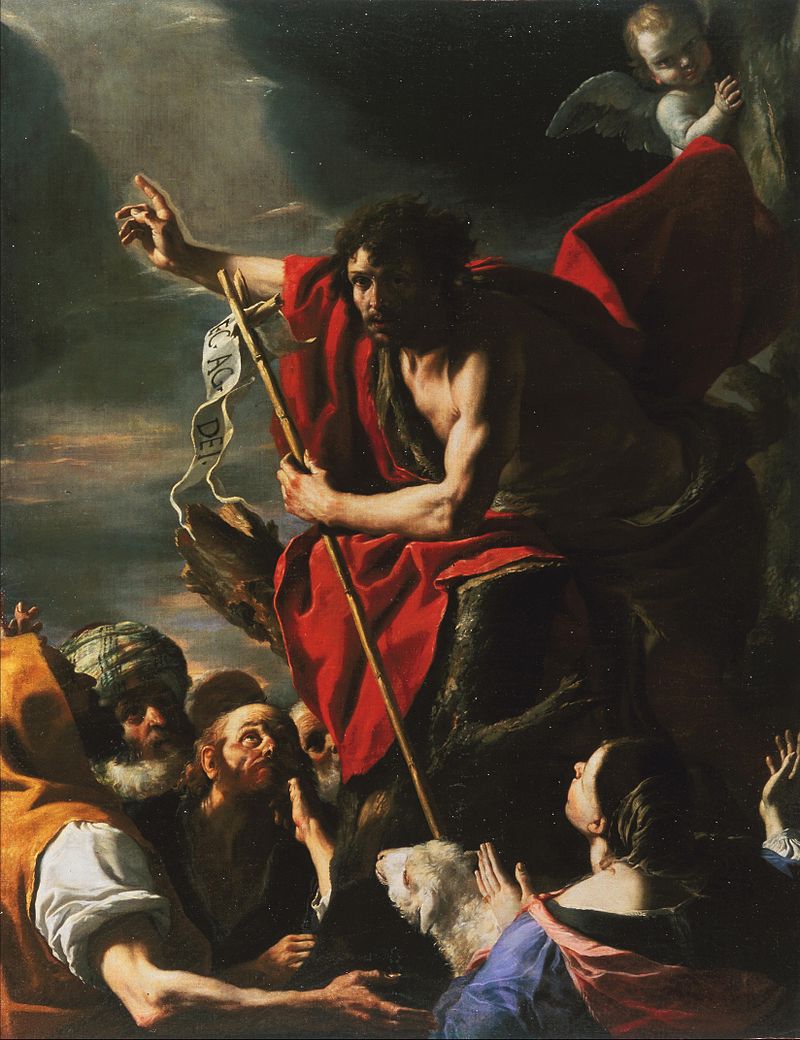
John the Baptist Preaching, by Mattia Preti, ca. 1665


After this "elegant beginning" to the ministry of the Baptist, our passage continues, telling us: "John went throughout the whole region of the Jordan," we learn, "Proclaiming a baptism of repentance for the forgiveness of sins" (Luke 3:3).

As the subsequent theological geology, taken from Isaiah 40:3-5, shows, the effect of the proclamation of the word of God is to completely reshape the world. By "world" I mean what Wittgenstein meant: "The world is all that is the case" (Tractatus Logico-Philosophicus, 1). It's easy to see why those for whom the present state of the world works well, or very well, might be inclined to outright reject the word of God. More insidiously, many are inclined to alter it in ways that make it congruent with the current state-of-the-world. This view calls for a certain passivity as we await a cataclysmic end to the world.

I presume anyone reading this has either accepted God's word or is at least not hostile to it in its true meaning, while rejecting its many "Christian" distortions. If you're like me, there's plenty in God's word to challenge and daily provoke you to wake up and begin participating in God's reign, which is already present, even if it's only the size a metaphorical mustard seed. This is what Advent, especially its first week, is all about. Very often we seem content to revel in syrupy sentimentalism.

If you've responded, or maybe more accurately, you're endeavoring to respond, or at least have not rejected God's word, then God has begun a good work in you. Through your cooperation and perseverance, God "will continue to complete it until the day of Christ Jesus" (Phil 1:6). It's time to let God's word cause an earthquake in your soul, thus changing your spiritual geography in order to conform you more to the image of Christ, whom we claim to follow, or at least whose message we deem worthy of our attention.

Saturday, December 8, 2018

Solemnity of the Immaculate Conception

Readings: Gen 3:1-9.15; Ps 98:1-4; Eph 1:3-6. 11-12; Luke 1:26-38

The most obvious way Catholics both honor the Blessed Virgin Mary and seek her intercession is by praying her Most Holy Rosary. As I suppose nearly everyone here knows, there are four sets of mysteries we can contemplate as we rattle the beads, as the old saying puts it.

By the grace of God, the Rosary of the Blessed Mary presents us with a set of mysteries we call “Luminous.” The Luminous mysteries allow us to contemplate key events in the Lord’s life and ministry. We also have the Sorrowful mysteries that bid us reflect on Jesus’s passion and death. Next, we have the Glorious mysteries, by means of which we contemplate Christ’s Resurrection, Ascension, and the descent of the Holy Spirit at Pentecost. The final two events we contemplate when meditating on the Glorious mysteries are Our Lady’s bodily Assumption into heaven and her Coronation as Queen of Heaven.

During the season of Advent, which we started last Sunday, we focus in a particular way on the Joyful mysteries of the Rosary. Of course, it is through the Joyful mysteries that we bring our attention to the events surrounding Jesus’s birth. First among the Joyful mysteries is the Annunciation. St Luke’s account of the Annunciation, which is the only account we have, is our reading for this Solemnity of the Immaculate Conception of the Blessed Virgin Mary.

To be clear, we celebrate the Annunciation as a Solemnity in its own right on 25 March each year. 25 March, as you might expect, falls exactly nine months prior to 25 December, the day on which we celebrate the Nativity, or birth, of our Lord and Savior.

What we celebrate today is the Blessed Virgin’s chosenness. Her wholly unique role in God’s plan of setting the world to rights. Once set right, God’s creation will be completed. Mary’s Immaculate Conception does not refer to the manner in which she was conceived. Mary, the Mother of God in the flesh, was conceived by her parents, who Tradition tells us were named Joachim and Anna, in the normal way. Her Immaculate Conception refers to the reality that by a unique and singular grace, through the merits of her Son, she was conceived without Original Sin.

Saying she was born without Original Sin, however, is to muddy the waters a bit. What her Immaculate Conception truly means is that, like our first parents, Miriam of Nazareth was born in the State of Original Grace. This is why our first reading is the account of our first parents’ fall from the State of Original Grace. It bears noting that the Church, practically from her beginning, sees the Blessed Virgin Mary as the new Eve.


It is in this State of Original Grace that God originally intended and still intends human beings, whom he made male and female in the imago Dei- the image of God- to live. For the rest of us, we are born into the State of Original Grace when are reborn through the waters of Baptism. But so strong is the weight of our fallenness that we tend to sin, even after being baptized. This tendency to sin after Baptism we call concupiscence. Nonetheless, as our reading from Ephesians tells us, like the Blessed Virgin, by virtue of our Baptism, we, too, are “chosen… so that we might exist for the praise of [God’s] glory” (Eph 1:11a.12a).

Each year during Advent we celebrate two great days for Our Lady: today’s Solemnity and the Feast of the Patroness of all the Americas, Our Lady of Guadalupe. I urge all of you to come next Wednesday, 12 December, for our celebration of Our Lady of Guadalupe.

The spiritual fruit of the first Joyful mystery is humility. The Blessed Virgin is nothing if not humble. When she is greeted by the Archangel Gabriel with such grand words, she cannot believe this angel of light is referring to her. This is why, upon hearing the angel’s greeting, “she was greatly troubled at what was said and pondered what sort of greeting this might be” (Luke 1:29 ). Once she received the news that she was to conceive a Son by the Holy Spirit- a development that put her at risk of being accused of serious immorality in her culture- she delivered her Fiat to Gabriel: “Behold, I am the handmaid of the Lord. May it be done to me according to your word” (Luke 1:28). Much to the delight of Star Trek fans, perhaps the most accurate way to translate the Latin word Fiat is, “Make it so!”

Arnold Geulincx, a little-known Dutch philosopher of the seventeenth century, in his best-known work, Ethica, wrote: Ubi nihil vales ibi nihil velis (John Calder, The Theology of Samuel Beckett, 16). What this sentence seeks to communicate is that where one is nothing, one should act accordingly, as though s/he is nothing. Because God is love, we are not made only something; through the Incarnation of his Only Begotten Son, God makes us children by rebirth in Baptism.

And so, my sisters and brothers, with the words of the Annunciation ringing in our ears, fresh in our minds, and hopefully rooted in our hearts, let us go forth and use this Advent season to humbly prepare ourselves to receive Christ anew. Praying the Joyful mysteries of the Rosary is a great aid in doing this. Christ wants to be born into the world through each of us and all of us together who comprise his Body. In his song “Distressing Disguise,” singer/songwriter and Bible scholar, Michael Card, beautifully tells us how this happens:
Every time a faithful servant serves
A brother that's in need
What happens at that moment is a miracle indeed
As they look to one another in an instant it is clear
Only Jesus is visible, for they've both disappeared

Friday, December 7, 2018

"This way or no way"

I spent a good part of the early afternoon today reading The Theology of Samuel Beckett by John Calder while listening to David Bowie's final album, Black Star. At least for today, prior to the beginning of the Solemnity of the Immaculate Conception of the Blessed Virgin Mary, which starts at sundown (about 5:00pm where I live), engaging in these activities constitute my rebellion against Christhaunkwanzika. I don't mind sharing that engaging in these activities feels to me like Advent: sitting in the dark waiting for a glimmer of light. Being a bit more honest, it's more accurate to say I am savoring the darkness a bit.

Commenting on Beckett's late work Worstward Ho, which he sensibly sees as the sequel to another of Beckett's undervalued late works, Ill Said, Ill Seen, John Calder, commenting on Beckett's take on blind evolution à la Charles Darwin, insists that for Beckett
Creation, growth and advance in terms of progress is not a positive thing but a disaster. Even Darwin did not perceive any benevolence in evolution, but only the continual advance of power. In economic terms capitalism exactly fits the description, and greed, which is the motivating force behind power, although looked at with a negative eye by much of civilized society, is certainly responsible for much of the suffering that pervades the world (The Theology of Samuel Beckett, 77)
Unsurprisingly, this is very Schopenhauerian. That Beckett was well acquainted with Schopenhauer's philosophy is a well-established fact.

Samuel Beckett

Worstward Ho takes Darwinian evolution as its starting point, while Ill Said, Ill Seen is Beckett's creation account. God is the narrator of Ill Said, Ill Seen. While Worstward Ho has clear Schopenhauerian bent, Ill Said, Ill Seen is rooted in the philosophy of one Arnold Geulincx (1624-1669), who was Dutch or, what amounts to virtually the same thing, a Flemish-speaking Belgian. According to Calder, Beckett came across Geulincx's Ethica almost by accident while a student at Trinity University in Dublin. According to Calder, as a young man, Beckett took to heart something Geulincx wrote: Ubi nihil vales ibi nihil velis (The Theology of Samuel Beckett, 16). What this sentence seeks to communicate is that where one is nothing, one should act accordingly, as though s/he is nothing.

This disciple of Descartes took his line of inquiry into the nature of God and the human condition way beyond Descartes's investigations. While Descartes endeavored to remain within the bounds of Catholic orthodoxy, Geulincx did not. Epistemologically, Geulincx was what is now called an occasionalist and an extreme one at that. In other words, he believed that God is the cause of all events and that human perception of cause and effect relationships is illusory. Metaphysically, this little-remembered Cartesian disciple saw "God as being so far away that he was not necessarily aware of our very presence, a remote group of intelligent beings on a far away planet" (The Theology of Samuel Beckett, 16). A metaphor of Geulincx that stuck with Beckett and is evident in virtually all his work is that an aware human being is like someone on a ship headed West but who wants to go East. The aware person cannot steer the ship eastward or get off the ship. short of death. Therefore, all s/he can do stand at the stern of the ship, thus placing herself as far East as she possibly can.

As far as what turned out to be Bowie's final album, I am eager to see a documentary released last year: David Bowie: The Last Five Years. Andy Green's review of this film, "Inside David Bowie's Final Act: New Doc Dives Into Lazarus," begins with this paragraph:
In October 2015, David Bowie decided to end his cancer treatments after learning the disease had spread too far to recover from. The very same week, he traveled to a Brooklyn soundstage to shoot a video for his new song “Lazarus,” the name of a biblical figure that Jesus brought back from the dead. Bowie spent the day in a hospital bed as cameras captured him with a bandage around his head. "Look up here, I’m in heaven," he howled. "I’ve got scars that can’t be seen"
In the anti-spirit of the of this soul-sucking season, I offer a second Friday traditio: "Lazarus" by David Bowie.


This way or no way
You know, I'll be free
Just like that bluebird
Now, ain't that just like me?

Feast of Saint Matthew, Apostle and Evangelist

Readings: Ephesians 4:1-7.11-23; Psalm 19:2-5; Matthew 9:9-13 Today the Church celebrates the Feast of Saint Matthew, Apostle and Evangel...