Showing posts with label Spirituality. Show all posts

Friday, July 24, 2026

"Use it any way you will"

My longtime leitmotif of the Καθολικός διάκονος Friday traditio is the fleeting nature of time. "Now" is just the intersection of the past and the future. Because now is super-fleeting, I am never at ease with the lazy exhortation to "live in the now."

Even living in the moment is problematic for me as a "life hack." You really have no choice but to live in the moment. My life unfolds moment to moment. Guess what? Every moment isn't and can't be all you want it to be. You see, there's something called reality.

In any case, today I had a wonderful moment. It was a moment that I can best describe as coming back to myself. Speaking of reality, as both of my readers know, 2026 thus far for me has been a steep climb.

Honestly, it's been a gift. I've really had to lean into God's unfailing and unconditional love for me. What happened today, the culmination of something that's slowly been happening over this week, is that I regained some self-confidence.


Over this year, I have been using a wonderful spiritual resource. It's book of daily reflections entitled An Ignatian Book of Days, edited by Jim Manney. More days than not, the daily reflection has hit me where I'm at, especially on many difficult days. Of course, on those days, I am more open, better disposed to listening with the ear of my heart.

Especially on a number of tough days, the reflections have not only been germane but also provocative. The acid test of spiritual advice or counsel is whether it holds up when things aren't going well. Let's face it, in the realm of spiritual counsel there is a lot of bullshit.

For example, this past Tuesday there was a reflection from an article by Mary Craig: "Suffering- Our Human Situation." The reflection ends with this suggested prayer:
For what it's worth, take it, God, and use it.
Use it to make me grow in compassion.
Use it any way you will
This morning, a few days later, I felt a great physical release. It was very real, very reassuring.

It's possible to care too little. It's also possible to care too much. I need to strive to better cultivate what Saint Ignatius called indiferencia. This is not apathy. Instead, it is the ability to let go of what does not help me. Having confidence in God's love is what enables me to do this. "In this is love: not that we have loved God, but that he loved us and sent his Son as expiation for our sins" (1 John 4:10).

Well, that's enough, especially on a day when I feel like I have nothing.

For our traditio today I am going with "War Pigs" by Black Sabbath. This version, from an Ozzy Osbourne tribute (it's been a year and a few days since his death), features an all star lineup with Post Malone singing. Note his hat. Spanish Fork is in Utah. Love it. I leave the insinuations and implications to you.

Saturday, July 4, 2026

Rest in the Lord

Readings: Zechariah 9:9-10; Psalm 145:1-2.9-11.13-14; Romans 8:9.11-13; Matthew 11:25-30

"See, your king shall come to you; a just savior is he."1 "The LORD is gracious and merciful."2 "Come to me, all you who labor and are burdened, and I will give you rest."3

Because the Lord is gracious and full of mercy, he comes to save us, to give himself "the just" savior for us, "the unjust," who need to be saved.4

We burden ourselves with so many things. We not only lay heavy burdens on ourselves but we lay them on others too. This is even true when comes to our spiritual/religious lives.

As Catholics, it may well be the case that this is especially true of us. There are rules to keep, laws to follow, and sin when rules are broken and laws ignored. Later on in Saint Matthew's Gospel, speaking about the Pharisees, Jesus says, "They tie up heavy burdens [hard to carry] and lay them on people’s shoulders, but they will not lift a finger to move them."5

While it's great to witness more people coming into the Church, it's easy to lose sight of the reality that more people are still leaving than coming in. Why? There is probably no single reason. But certainly one reason is that religion easily becomes neurotic, demanding, impossible. This lies at the heart of a lot of deconstruction narratives.

Let's face it, life is often difficult. Because he is gracious and merciful, Jesus offers us his easy yoke in exchange for our heavy one. He asks you lay down your heavy burdens and take up his light yoke, one that is much easier to carry.

Jesus' own yoke was the cross. The weight of the cross, which doesn't only refer to the heavy wood but to our burdens that he took upon himself, is the Lord's yoke. Its weight was crushing. While he urges us to take up our crosses, he helps us carry them, making them lighter, even light.


You may have heard the phrase "a yoke of oxen." A yoke is a wooden harness of sorts, slipped over the head of at least two oxen so that together they can pull something heavy. Both the yoke and what the animals pull are heavy, requiring a lot of energy and labor.

Our Lord carried your heavy burden so you don't have to. He didn't do this because you deserve it. Rather, he did it because you don't. He did it because he loves you; mind boggling.

Most if not all of us have experienced life's burdens. I am not writing here about the burden of those things we do wrong, which are burdensome. I write about all of life's burdens: disappointments, illness, disllusionment, job worries, financial pressures, concerns for children, self-doubt, the death of a loved one, etc.

What is it the Lord teaches the one who seeks to learn from him? First and foremost, it is to trust him, to place your worries, cares, that is, your burdens before him. This requires meekness and humility. It also requires honesty with yourself and with him.

Elsewhere, scripture urges us to humble ourselves under the mighty hand of God, which is not meant to be threatening but rather ressuring us that it is God who is in control. And so, the passage continues, "Cast all your worries upon him because he cares for you."6

I am currently reading through Scott Sauls' book The Mercy King. While I am reading it as part of my preparation for a retreat I am leading this fall, I am finding it very personally beneficial. "Jesus," Sauls notes when writing on this passage from Matthew, "doesn't approach us as a harsh taskmaster, pointing out flaws or keeping score." Rather, he issues each one of us a deeply personal invitation.7

Sauls rightly points to the fact that at the heart of the Lord's invitation are three words (it is also three words in the original Greek): "Come to me."8 Jesus doesn't say, Come and wow me with your intelligence, creativity, diligence, or even any virtue you've maybe acquired. No. He says, Come to me just as you are, the more tired the better, and I will give you rest.

________________________________________________________

For some reason, this summer I am really inclined to stick with the basics of the Gospel. My focus is on the great love the Father has lavished on us in Christ Jesus. It is the Holy Spirit who pours God's love (which is nothing other than God, who is love) into our hearts.9 This is the sure foundation of the Gospel of Jesus Christ. You can't earn this. You can only respond in love with thanksgiving.


1 Zechariah 9:9.
2 Psalm 145.8.
3 Matthew 11:28.
4 1 Peter 3:18.
5 Matthew 23:4.
6 1 Peter 5:6-7.
7 Scott Sauls. The King of Mercy: How the Kindness of Jesus Heals Your Sin, Shame, and Weakness, page 123.
8 Ibid.
9 Romans 5:5; 1 John 4:8.16.

Wednesday, June 3, 2026

The vulnerability of parental love

For my morning prayer time this year, I have been using a book I found in a discard pile: An Ignatian Book of Days. Put together by Jim Manney, the book consists of curated meditations for each day of the year. This book has been a boon for my spiritual life.

As a husband and as a father, one who, along with my wife, has been going through our most challenging time in more than thirty years of parenting the past year-and-a-half (I will spare you the details and safeguard my child's privacy), I was particularly struck by the extended extract from another book, written by Carmelite nun Ruth Burrows: Essence of Prayer, that was today's meditation from An Ignatian Book of Days.

I am not sure that consoling is the best word to describe the effect of what Burrows wrote had on me. I would have to go with hopeful. As longtime readers know, I have a very specific take on hope.
Consider a blissfully happy couple finding all they need is one another. For no other reason than generosity and the desire to share their happiness, they decide to adopt children as their own. From then on their life undergoes a profound change. Now they are vulnerable, their happiness is wrapped in the welfare of the children; things can never be the same again.


If the children choose to alienate themselves and start on the path to ruin, the couple are stricken, They will plead, humble themselves, make huge sacrifices go out of themselves to get their loved ones to understand that the home is still their home, that the love they have been given is unchanging.

This perhaps gives us some insight into redemption. In a mystery we cannot fathom, God "empties," "loses" Himself in bringing back to Himself His estranged, lost children. And this is all the Father wants. This is the only remedy for His wound. God is no longer pure God, but always God-with-humanity-in-his-heart
On a theological note, the Incarnation practically forces you to dump your Aristotelianism and your Platonism. As Pascal learned, the God of the philosophers is not the saving God, the God of redemption and liberation, God as revealed in Jesus Christ.

It is, of course, through Christ by the power of the Holy Spirit that, in baptism, we become children of God by adoption (the Father has only one begotten child, a Son).

As parents of six children, my wife and I have experienced our share of ups and downs, joys and sorrows, consolations and desolations. We haven't dealt anything of the magnitude of what we are currently enmeshed in. "Now they are vulnerable," indeed! Thank God fo that.
It is truly right and just, our duty and our salvation,
always and everywhere to give you thanks, Father most holy,
through your beloved Son, Jesus Christ, . . .
While I am not one of those who thinks spiritual truths need to validated empirically and scientifically (I am more one who is like, "Duh, of course many of these things bear out empirically!"), here is an article that I found useful: "The Good Kind of Vulnerability."

Sunday, May 31, 2026

Solemnity of the Most Holy Trinity

John 3:16-18

According to the Church, it is possible for a person to come to the knowledge that there is a God on the basis of natural reason alone, that is, unaided by divine revelation. Hence, belief in God can be called a truth of reason, as opposed to a truth of faith. Of course, natural reason aided by divine revelation strengthens and fortifies this a belief.

To know that God is a Trinity of persons- Father, Son, and Holy Spirit- revelation is required. And so, knowing God as a Trinity, one in being and distinct in person, is a truth of faith. To be clear, truths of faith are not contrary to reason. This is why Saint Anslem of Canterbury's definition of theology still perhaps remains the best: fides quaerens intellectum- faith seeking understanding.

What I like most about the Gospel reading for Year A of the lectionary for the Solemnity of the Most Holy Trinity is that it gives us the starting point for Christian theology. Christians do not start with the Most Holy Trinity. Rather, Christian theology begins with the revelation of God in Jesus Christ. We start with Jesus Christ, in whom God revealed everything he could reveal.

The Trinity icon, by Andre Rublev, 15th century


"God is love" (1 John 4:8.16). God is self-giving, self-sacrificing love. "God [the Father] so loved the world that he gave his only Son. . . " (John 3:16). And the Son so loved the Father that he loved us enough to give himself. The love between the Father and the Son is a person: the Holy Spirit.

It is through Christ and by the power of the Spirit that we are made children of the Father by rebirth through the waters of baptism. In baptism, you are plunged into the very life of God, into that perfect communion that is the Most Holy Trinity. Andre Rublev's amazing Trinity icon beautifully shows this.

From the vantage point of the person looking at this icon you see an open semi-circle- three person serenely seated at table. The open space at the table, the one the viewer already occupies, even if from a distance, is your place. You are invited to the table. You are invited into the very life of God- Father, Son, and Holy Spirit.

As we prepare for next week's Solemnity of the Body and Bloody of Christ (Corpus Christi), let's bear in mind that the Church, too, is a communion of person. We are the Body of Christ. As Christ's Body, our communion is to show forth in a visible and tangible way blessed communion of Father, Son, and Holy Spirit.

This is the last post of May!

Wednesday, May 6, 2026

Reflection on the Blessed Virgin Mary

May and Mary differ by only one letter. Since May is traditionally the month dedicated to our Blessed Mother, maybe we should just call it “the month of Mary,” as in January, February, March, April, Mary, June. Well, it’s easier than somehow trying to derive “Rosary” from October, right?

May is a beautiful month. Along with October, it is a transitional month. It is in May that the annual cycle of nature, coming alive during Spring, reaches completion. It is generally a time of blue, sunny skies and generally mild temperatures. A time before the heat of summer begins.

May is a colorful month. A month when nature produces vivid colors: blue sky, green grass and trees, red, white, yellow, purple, and orange flowers. May also feature clear, rushing streams, the snow of winter melting into water. Most years, like this one, most of Mary's month falls during the sacred season of Easter.

It’s odd that the Blessed Virgin Mary has become a stumbling block to Christian unity. She has been venerated in a unique way since the beginning of the Church. An example of this is the Glorious Assumption, which is celebrated each year on 15 August by both Catholic and Orthodox Christians. The major Protestant Reformers- Luther, Calvin, and Cranmer- all continued to venerate our Blessed Mother.


Like praying for the dead, seeking the maternal assistance of holy Mary, Mother of God, is a fundamental Christian practice. How could the woman chosen to give birth to God’s only Begotten Son not somehow stand out? Just as the Son is consubstantial with the Father as to His divinity, through His Blessed Mother, He is consubstantial with us pertaining to His humanity.

Just like I can’t pass up the opportunity to use the words “penultimate” or “juxtapose,” I can’t do a reflection on our Blessed Mother without at least mentioning hyperdulia. It’s a cool word. One reason why some non-Catholic Christians question devotion to Mary is that they mistakenly believe that we worship her.

Commandment one bids us worship God and God alone. In Greek, this is called latria. Far from worshiping the saints, we venerate them. The Greek word for this is dulia. The Blessed Virgin Mary falls into her own special category, one that lands somewhere between latria and dulia. This category does not rise to the level of worship but remains higher than veneration: hyperdulia. The prefix hyper means over, beyond, or even excessive.

So, during the month of Mary, let us rely on her maternal care, asking her to intercede for us daily through her Holy Rosary, during Easter by reciting the Regina Caeli. And by frequent use of her Memorare:
Remember, O most gracious Virgin Mary,
that never was it known
that anyone who fled to thy protection,
implored thy help, or sought thy intercession,
was left unaided

Sunday, April 12, 2026

Divine Mercy Chaplet w/ Exposition

By the mercy of God, we come before our Risen Lord, present in the Eucharist. His Eucharistic presence is a present, a gift flowing from Divine Mercy. In a few moments, praying the Chaplet of Divine Mercy, given mystically to Saint Faustina Kowalska, we implore the Father for the sake of His Son’s sorrowful passion, to have mercy on us and on the whole world.

By praying the Chaplet of Divine Mercy together, we intercede for the world before the Father, through the Son, in the power of their Holy Spirit. We ask God to have mercy on the world and on us. Yesterday, Pope Leo held a Rosary Vigil for peace Saint Peter’s Basilica. At same time locally, there was a Rosary procession in Salt Lake City, which began and ended at our cathedral. This gathering is an extension of the Holy Father’s vigil.

In a memorandum issued last Thursday, Bishop Solis directed that in all prayerful gatherings of the faithful in our diocese this Divine Mercy Sunday, we pray for peace throughout the world and for respect for the human dignity of migrants and for their safety. In obedience to our bishop, this Chaplet of Divine Mercy is offered for those two intentions. Of course, it is right and fitting to add your own intentions to these communal intentions, just as at Mass.

Evil is real. I am not sure I agree with the assertion that evil is merely a lack. Evil seems to me, at least at times, to have some substance. In a world full of chaos and uncertainty, where, as Pope Leo noted in his new year’s address to the ambassadors accredited to the Holy See, war, with all its concomitant suffering, seems to once again be in vogue. This causes many to wonder if evil has any limit.

Toward the end of his life, Pope Saint John Paul II, who was instrumental in Saint Faustina’s canonization and who established the Second Sunday of Easter as Divine Mercy Sunday, wrote about the limit God imposes on evil.


John Paul II insisted you can’t “think of the limit placed by God himself upon the various forms of evil without reference to the mystery of Redemption.” He then asked, “Could the mystery of Redemption be the response to that historical evil which, in different forms, continually recurs in human affairs?” Before jumping too quickly to give a facile answer to a complex question, he annunciated some of the evils. All too easily, he insisted, we can come to see
the evil of concentration camps, of gas chambers, of police cruelty, of total war, and of oppressive regimes - evil which, among other things, systematically contradicts the message of the Cross - it can seem...that such evil is more powerful than any good
He then urged us to pay close attention to history. Doing so, “we discover that this is precisely where the victorious presence of Christ's Cross is most clearly revealed.” Against a dark background the light shines forth more brightly. For “those subjected to systematic evil, there remains only Christ and his Cross as a source of spiritual self-defense, as a promise of victory.”

According to John Paul II, it is the Cross of Christ that “marks the divine limit placed upon evil, it is for this reason only: because thereby evil is radically overcome by good, hate by love, death by resurrection.”1

It is only by bearing your cross daily and giving your life in loving service to others that you can experience resurrection, that is, in the words of Saint Augustine to the wealthy Roman widow Proba, life that is truly life!

Take courage, by His death and resurrection, Christ conquered evil and death. By His passion, death, and resurrection, Christ not only responds to all the evil in world, He vanquishes it. Christus resurrexit, quia Deus caritas est - Christ is resurrected because God is love.


1 All citations from John Paul II. Memory and Identity: Conversations at the Dawn of the Millennium, 19-20. Random House: 2005.

Friday, March 13, 2026

"But for now we live on these streets"

Friday the thirteenth!!! As noted in my last post, I am not supertitious. Superstition is really quite a pagan disposition toward reality, not a Christian one.

Is thirteen considered unlucky because that is how many steps to the gallows or are there thirteen steps to the gallows because that number is unlucky?

As I have noted a few times over this Lenten season, mortality is a reality of which one must remain mindful. This is the point of the "Remember you are dust..." exhortation on Ash Wednesday. After a certain age, however, one is frequently reminded. Viewed strictly in the horizontal plane, we're all making our way to the gallows.


Even for someone who believes in and has hope for eternal life, death remains the horizon over which it is impossible to see. Let's be honest, even as people of faith, apart from resurrection, we don't really know what happens after we die. We especially don't know what we will experience between death and resurrection. Since we don't believe that we are souls trapped in bodies, a thoroughly Gnostic notion, what might it be like to be a disembodied soul?

I am not going to attempt to answer that question.

Momento mori- Remember death. Not only will your mortal life not last forever, it is very short. This is true even if you live to be 100!

Life's shortness should cause everyone to ponder life's meaning. This begins with the uncomfortable question, Does life have meaning? Having a meaning is what gives life purpose. Purpose gives direction. Being Christian is not just a way of life but a mode of being. Our direction is following Christ.

Just as practicing Christians tend to recoil at "I'm spiritual but not religious," Catholics are equally dismissive of the dichotomy between religion and relationship made by Evangelicals. But for a Christian, religion (i.e., right worship) requires relationship. Hence, it is the Catholic both/and. If it's just religious observance, then you are only going through the motions. One shouldn't hold onto either horn of a false dilemma. And, believe it or not, it isn't always better to go through the motions.

There are no small number of people who were raised Catholic, became Evangelicals, and returned to the Church. Most will tell you that detour was an important part of following Christ. I think this observation is important because Lent isn't about being more religious for a concentrated period of time. It's about opening yourself up to God's grace, seeking a deeper relationship with Christ by the power of the Holy Spirit.

While I would never dissuade someone from adhering to the five precepts of the Church and, in fact always urge them to do so, I would say that sometimes, maybe especially during Lent, religious observance can be a dam rather than a channel of divine grace. I don't mind repeating this Friday that what the Lord is helping me with during this holy season is being more gentle with myself and extending that gentleness to others.

Our traditio for this Friday of the Third Week of Lent is Rick Elias' "A Man of No Reputation," which was recorded on The Jesus Record. It was a song slated to come out an album Rich Mullins was working on at the time of his death. Instead, it came out on a posthumous record.

The lyrics from this song I used as the title for this post reminded me of Madeleine Delbrêl's "We, the Ordinary People of the Streets." In this piece she insisted:
We, the ordinary people of the streets, believe with all our might that this street, this world, where God has placed us, is our place of holiness

Wednesday, March 4, 2026

Letting go of Why?

Why? It is the most human of all questions. As human beings, we are creatures of meaning, always deeply desiring meaning. We often tend to manfacture meaning. Because this question is human, all too human, it is limited. Hanging on to "Why?" limits you.

The Book of Job shows what happens when one clings to "Why?" In the end, Job doesn't really receive a satisfying answer to his question. Rather than asking "Why?", it's usually more important to grapple with "that."

That really happened. What now? It's okay that you can't make sense of it. I am of the view that in a fallen and badly broken world, there is often no sense be made of things. And so, it's very often the case that any meaning you assign is an overlay, an imposition, a figment of your imagination. This is especially true when trying to determine someone else's intentions. Most of the time, we don't know our own reasons why!

Most of the Book of Job consists of either Job's friends trying to answer Job's "Why?" or Job rejecting their facile answers (i.e., God is punishing you because of something you did) even as he continues imploring God. In the end, the divine answer Job receives can be summarized by this passage from Isaiah:
For my thoughts are not your thoughts, nor are your ways my ways . . . For as the heavens are higher than the earth, so are my ways higher than your ways, my thoughts higher than your thought (Isa 55:8-9)
When reality is overwhelming, disorienting, bad, or even traumatic, "Why?" is a natural response. Like a lot of natural responses, the Spirit leads us beyond that. In his lovely little book Prayerfulness, Robert L. Wicks inists that "until we can let go of this question ["Why?"] and find new ways of relating to God and the event, moving on and moving deeper in our life is almost impossible" (90).


Perhaps the most pagan way of relating to God is to think that when something bad happens God is punishing you and when good things happen it is because God is pleased with you. God is not capricious. God is probably never the formal cause of what happens to you. Perhaps sometimes He might be the efficient cause. God is certainly the final cause of all things. If we're willing to let go of "Why?", God can and will make amazing things happen. Only God can bring life from death and create something from nothing.

Trust is earned. Trusting someone, even God, involves a risk. Most of the time the risk isn't whether or not things will work out for the better or maybe even just be okay. Rather, the risk is not having things work out the way you want them to. What we often want is for bad things to just go away. Far from being an evasion of reality, Christian faith is a deep engagement with reality. Hope is realized by facing reality squarely.

More than God's pleasure or displeasure, I think the worst temptations are not to believe in God or to believe God is indifferent toward you. Of these two, the latter is worse than the former. We are not to put God to the test, which, scripturally, refers to trying to force God to do what you want Him to do. Trusting God when reality seems arrayed against you, which requires submission to His holy will and realzing that it isn't just all going to magically go away, is necessary. This means having no idea how this is going to work out or how I am going to make peace with this and imploring God, surrendering to Him.

As Eugene Peterson wrote: "When nothing we can do makes any difference and we are left standing around empty-handed and clueless, we are ready for God to create."

Friday, February 20, 2026

"Have mercy on me, God"

Today is the Friday after Ash Wednesday. I always think of Ash Wednesday to the following Saturday as the warm-up period for Lent. Then, on the First Sunday of Lent, the season really kicks in.

Repentance gets short shrift these days. It sometimes seems that to suggest there are things in all of our lives that need to change is an affront to human dignity. It's uncomfortable to adhere to the belief that we're broken people living in a fallen world. In the age of "identity," it's important to point out that a Christian finds her/his identity in Christ. This puts us in a mode of becoming.


It's easy to the believe that "the world," which is an abstraction, is fallen, or even that "humanity" (another abstraction) is broken. It's harder to believe that I am. It's downright challenging to believe that the most important thing I can do to change the world is to change myself.

In a pamphlet translated from Russian into English in 1900 and given the English title "Three Methods of Reform," Leo Tolstoy addressed this head-on:
There can be only one permanent revolution — a moral one; the regeneration of the inner man. How is this revolution to take place? Nobody knows how it will take place in humanity, but every man feels it clearly in himself. And yet in our world everybody thinks of changing humanity, and nobody thinks of changing himself
For anyone who has attempted to change himself, you know, while such an undertaking can bear some fruit, it usually proves futile.

As a Christian, I believe I need God's help to make the changes that I really need to make. This help is usually termed "grace." In the Act of Contrition, at least the one I use, this is acknowledged. Praying to God, the penitent pledges, "I firmly intend, with Your help, to do penance, to sin no more, and to avoid whatever leads me to sin."

I would think that the Lenten disciplines one undertakes would have some correlation to what one needs to change, either to embrace or to avoid. What you take up during Lent is as important, if not more so, than what you give up. One clue to this assertion is that the Collect for Ash Wednesday refers to Lent as "this campaign of Christian service."

is While being conformed into the image of Christ isn't something you can achieve solely by your own efforts, it does require your effort, your cooperation. This is what the holy season of Lent urges us to do more intentionally. It is a time to reassess, to recommit, to endeavor to live the new life you received in baptism. Lent is preparation for the renewal of your bapstimal promises at Easter.

Whenever I remember it, I am deeply moved by Pope Francis' response to the first question he was asked by Father Anthony Spadoro, a fellow Jesuit, in a lengthy interview at the beginning of his pontificate. The question was Who is Jorge Mario Bergoglio? His reply? I do not know what might be the most fitting description…. I am a sinner. This is the most accurate definition. It is not a figure of speech, a literary genre. I am a sinner.

Nonetheless, Lent, which means "springtime," is not the time wallow in your unrighteousness. It is a time to change with God's help by realizing how much God loves you, even as you struggle or fail. As Saint Paul wrote to the Roman Christians: "But God proves his love for us in that while we were still sinners Christ died for us" (Romans 5:8)

Our traditio is what else but a choral rendition of Psalm 51, the Miserere.

Thursday, January 1, 2026

"No man is perfect in holiness..."

For a number of years now, either on New Year's night or the evening before I have to go back to work at the end of Christmas, I've selected a passage from Thomas à Kempis's The Imitation of Christ and posted it. I've even done this during years when my effort here kind of flagged a bit. I am gearing up to re-read this spiritual classic over Lent, which, this year begins 18 February.

The Imitation of Christ, along with Brother Lawrence's The Practice of the Presence of God, the latter being a work Pope Leo holds in high regard, are about nurturing an intimate relationship with Christ. What we celebrate at Christmas is what makes such a relationship possible. Dealing with temptation is not a subject about which you hear much these days. Nonetheless, these abound. Given Pope Francis' deeply insightful "take" on what he called "a culture of indifference," omissions are temptations, too.

Therefore...
So long as we live in the world, we cannot be without trouble and trial. Wherefore it is written in Job, The life of man upon the earth is a trial.(Job 7:1). And therefore ought each of us to give heed concerning trials and temptations, and watch unto prayer, lest the devil find occasion to deceive; for he never sleepeth, but goeth about seeking whom he may devour. No man is so perfect in holiness that he hath never temptations, nor can we ever be wholly free from them (The Imitation of Christ, Book I, Chap. 13, 1)


Peace to you as you embark on another year. On this the Solemnity of Mary, the Mother of God, I prayed a Rosary for all who read this. Emmanuel- our God is with us. Remember this!, God is with you.

Saturday, July 26, 2025

Persist in prayer

Readings: Genesis 18:20-32; Psalm 138:1-3.6-8; Colossians 1:12-14; Luke 11:1-13

At root, our readings for this Sunday are about prayer. Listening, we learn about the importance not just of prayer in general but of petitionary prayer that is intercessory in its orientation. To be clear, by petitionary prayer, I refer to petitioning God for specific intentions. By intercessory prayer, I mean petitioning God on someone else's behalf.

In our day, there seems to be a loss of the belief in the efficacy of prayer. Why pray? It doesn't change anything. Even many genuinely pious people seem to focus merely on accepting whatever happens as God will, which they assume is predetermined. Why seek to cut against the grain of how reality seems to be working?

Now, don't get me wrong. We do need to learn how accept all things from God. This is no easy task. For many, it is crushing and understandably so. It's very important to grasp that not all outcomes are directly willed by God. God sometimes permits things without willing them to realize some some greater good. Let's never lose sight of the fact that God is in the resurrection business. God brings life from death and always seeks to do so, causality notwithstanding.

The question I always come away with after reading about Abraham's petition to God on behalf of Sodom and Gomorrah is, What if he had persisted with God down to one? I realize that this opens a can of theological worms. Let's bracket those concerns and persist with the question what if? Would the cities have been spared had Abraham been more persistent?

If we take the Gospels as we should, which is as God's revelation because these texts accurately hand-on Christ's teachings, it is clear that we should be persistent in our prayers not only those for others but those made on our own behalf. Jesus' teaching is clear: persist! Keep asking, keep petitioning, keep praying. How many years did Saint Monica pray for her son, Augustine? Don't let up. The Lord is telling us in very practical terms how to pray.


Lest you think our reading from Colossians has no bearing on our readings from Genesis and Luke (great effort being made during Ordinary Time to harmonize the Old Testament reading with the Gospel), it has a lot of bearing. To wit: we become children of the Father through Jesus Christ by the power of the Holy Spirit. This happens in baptism when you were baptized in the name of the Father, and of the Son, and of the Holy Spirit. You were reborn in baptism as a child of God. Not only were you reborn in baptism, you died, were buried, and rose with Christ to new life. Life, death, and love, as all of us seem to know intuitively, are intricately interwoven.

It pleases our Father to give you the Holy Spirit. It pleases Him to hear and answer the prayers of His children. So, don't pray by throwing up some half-digested desire. Recollect yourself, gather up all that is in your heart, consider the needs of people you know, pay special attention to those who have asked for your prayers. Then, pray to God, asking directly for what you want.

As the late Herbert McCabe, OP, wrote about prayer:
Our stance in prayer is not simply, or even primarily, that of the creature before the creator but that of the Son before the Father. At the most fundamental level, the level which defines prayer as prayer, we receive from the Father not as creatures receiving what they need to make up their deficiencies, but as the Son eternally receives his being from the Father1
Summarizing McCabe's take on prayer, Edmund Waldstein, O.Cist, provides an important insight:
Fr. Herbert McCabe, O.P., used to say, that it is necessary to pray for what you really want— not to dissemble your desires. Distraction often comes, because we dissemble and do not recognize what we really want. And because at the beginning of spiritual life, our desires are often stupid and pointless, our prayers too will be stupid and (apparently) pointless. But those who persevere in prayer will find that God transforms their desires. And the more they are transformed, the more the stupidity and pointless will give way to a real communion with God2
Nonetheless, returning to McCabe, it is important to recognize "All our prayer is, in a very precise sense, in Spirit and in truth. For us to pray is for us to be taken over, possessed by the Holy Spirit which is the life of love between Father and Son."3

One of two things: keep praying, pray and then pray some more or start praying and then keep praying. Trust that will transform you through prayer. Also trust that God hears and answers prayers. This is experiential, not systematic, not doing x number of repetitions of A will inevitably result in B. Such nonsense is, far from being scientific, is superstitious.

Maybe in your prayer life you need to clear the deck and begin again. It's okay, as Father M. Louis said of the spiritual life, "We do not want to be beginners. But let us be convinced of the fact that we will never be anything else but beginners all our life!"4


1 Herbert McCabe, O.P., God Matters (London: Continuum, 2005), 220.
2 Ibid.
3 Edmund Waldstein, O.Cist., "Prayer Begins in Pointlessness and Stupidity," Church Life Journal, 27 June 2018.
4 "Thomas Merton/Always Beginners"

Friday, March 7, 2025

"... renew within me a steadfast spirit"

For Roman Catholics, Ash Wednesday and the three days that follow are something of a warm-up for Lent. What we call the three days following the start of Lent indicate this. For example, liturgically, today is Friday after Ash Wednesday. By contrast, next Friday is the Friday of the First Week of Lent.

Hearkening back to my homily for Ash Wednesday, Psalm 51, the Miserere, is the first Psalm of Morning Prayer for today. Along with Evening Prayer, Morning Prayer is a "hinge" hour of the Liturgy of the Hours. Morning and Evening Prayer are the hinges on which the other five hours (or offices) swing. At least in the United States, Morning Prayer and Evening Prayer, the hinge hours, are what deacons are obligated to pray.


There are times, especially during Advent and Lent, when I mix this up a bit and pray the Office of Readings and Night Prayer, thus maintaining my ordination promise to faithfully pray the Liturgy of the Hours with and for the people of God. I start praying the Office of Readings on the Fifth Sunday of Lent, when this office consists of reading from the Letter to the Hebrews, which is one of my favorite books in all of Sacred Scripture. This goes on through Holy Week.

It bears noting that except when a solemnity falls on Friday (I include Friday in the octaves of Christmas and Easter in this), Fridays throughout the year are days of penance. So, just as every Sunday, even during Lent, is a little Easter, each Friday is a little Lent. As my long history on this blog shows, I believe this practice to be very important.

In Psalm 51 we pray: "A clean heart create for me, God; renew within me a steadfast spirit" (v. 12). I don't know about anyone else, but the plea for "a clean heart" is for me a constant plea. But especially this Lent, I am asking God to renew in me a steadfast spirit. If I had to describe 2025 thus far in one word that word would be destabilizing.

Being destabilized is not all bad. I've been struggling through the gateway to a new season of life. This has meant discerning where it is the Lord is leading me, where He wants to me go. I am a bit like the rich young man, except I am no longer young and not terribly rich. Following Jesus always comes at a cost. What is the reward for following Jesus? Jesus!

Lent is a blessed season. With everything going on, all the rancor, vitriol, uncertainty, and, yes, what seems like destabilization, it probably seems to many people that Lent began early. This is understandable. For many, Pope Francis' health crisis only adds to the cloudiness of the present moment. It seems we all need to be renewed with a steadfast spirit.

Since I've already invoked Hebrews, let us not lose sight of this revealed truth: "Jesus Christ is the same yesterday, today, and forever" (13:8). Jesus is Lord is much more than an empty, that is, political, slogan.

All political slogans are ultimately empty. All ideologies contain the seeds of their own destruction. They cannot deliver on their promises because what they promise is ultimate and politics are provisional, transitory. When it comes to political engagement, it is vital for Christians, eschewing ideology, to exercise prudential judgment. Being, in the words of Jesus, "shrewd as serpents" and, at the same time, "simple as doves" (Matt 10:16).

What is more worrisome about ideologies is that they can destroy their adherents and decimate socities. Christians need to resist those that seek to co-opt Christianity and/or the Church in the service of an ideology. I believe there is an inverse proportionality between how loudly a politician proclaims his/her Christian allegiance and the actual Christian nature of their politics in one way or another. If nothing else, such a stance lacks humility.

Don't get me started on politicians parading around with ashes on their foreheads. It would be far more convincing if they also sported sack cloth suits. So much American Christianity is performative these days. We put the scribes and Pharisees to shame. "Show your ash," indeed!

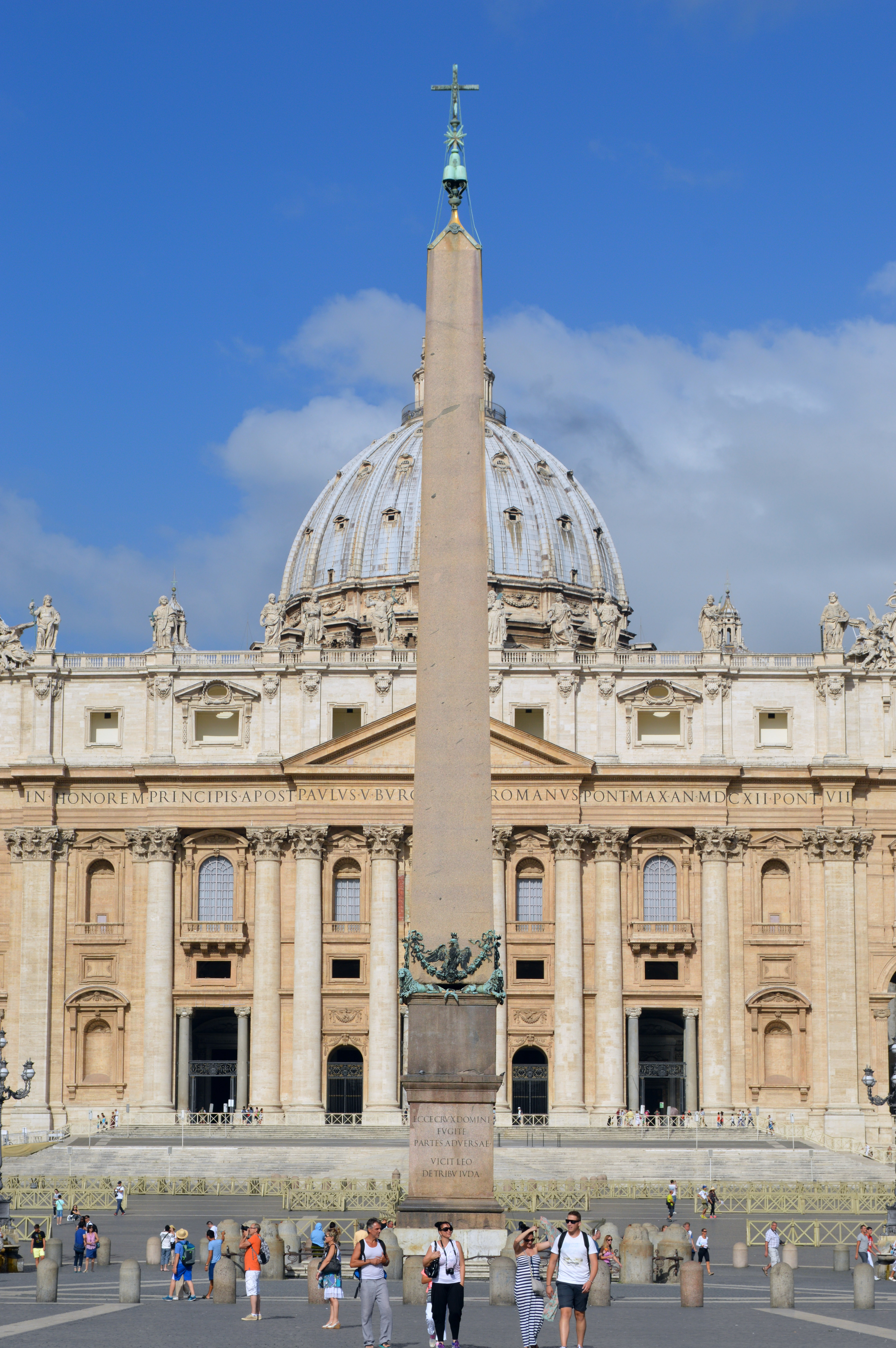
I think of a story of the late Msgr Lorenzo Albacete, who, on a visit to St. Peter's Square, pointed to the Egyptian obelisk and said something to the effect that it is flipping the bird to all the ideologies of the world. This is an interesting "take" to be sure.

It should come as no surprise that our traditio for this Friday after Ash Wednesday is the Miserere. Specifically, sung by The Sixteen, it is the Miserere composed by Gregorio Allegri most likely in the 1630s, during the pontificate of Urban VIII. It was intended to be used exclusively in the Sistine Chapel during Tenebrae services of Holy Week.

Saturday, March 1, 2025

Last Sunday before Lent

Readings: Sir 27:4-7; Ps 92:2-3.13-16; 1 Cor 15:54-58; Luke 6:39-45

I want to begin by making a clarification: the opposite of pessimism is optimism and optimism is not hope. One can be a pessimist and still have hope. I know because c'est moi. My hope is in God and in God alone. In the person of Jesus, God became human. God is one of us! As Saint Paul notes in today's "epistle" reading, it was by becoming one of us that He was able to die and rise. Jesus conquered sin and death. This is my hope.

Hope is made manifest in reality. Every Spring is a resurrection. Every morning that I awake is a resurrection. Every dark valley I have passed through and come out the other side verifies my hope. It also enhances my trust in the One who walks with me through valley of the shadow of death, which is a poetic way of referring to the One who walks with me on the journey of life.

As unrelated as it might seem to the other readings, as is often the case during Ordinary Time, when the lectionary seeks to explictly connect the Old Testament reading to the Gospel, thus, more often than not, leaving the epistle reading to fend for itself, there is a connection between our passage from the fifteenth chapter of 1 Corinthians and the Gospel.

Eternal life doesn't begin after physical death. To live on that basis is to wish more than hope. Rather, eternal life begins when, after having died and been buried in the waters of baptism, you emerge, come forth, arise. From that point forward, your life should look different, should be different, a change from how you previously lived, a life characterized by Jesus' teachings.

In short, as Christians, our lives should look redeemed. As Nietzsche intimated, too often Christians don't look or seem redeemed.

Lent starts Wednesday. Ash Wedensday to the First Sunday of Lent is kind of a Lenten warm-up period. Lent is the time to repent. While repentance starts with acknowledging and being heartily sorry for one's sins, it does not consist only or mainly of that. Let's eschew what Bonhoeffer famously called "cheap grace." To truly repent is to endeavor, with God's help, to live a more Christ-like life.


Like Job, Eccelesiastes, Proverbs, Psalms, the Song of Solomon, etc. Sirach is a wisdom book. As such, it contains divine wisdom. Our passage from this wisdom book urges you to be careful what you say, to be patient in tribulation, to pay attention to what others say and how they say it.

When it comes to judging, it is important to clarify things. First, we inevitably make judgments all the time. Guess, what, this is fine, even necessary. This even extends to matters of good and evil. Let's face it, you can't live very long without making a judgment. But, in ultimate terms, judgment belongs to God alone. Whether applied to yourself or others, what Jesus says is true: "from the fullness of the heart the mouth speaks." Speech provides a basis for judgment.

Be measured and prudent even when, maybe especially when, you're speaking critically on some matter about which you care deeply. By all means, speak the truth, call out lies, do so courageously, stand up for the downtrodden, warn others not to eat rotten fruit, but don't hate. Don't let your heart be contaminated with poison. Trust me, I understand that living in a toxic culture increases the risk of spiritual cancer. But you can take measures to ensure you don't get sick.

Here are some of Jesus' prescriptions to protect you from the toxicity that frequently engulfs us: prayer, fasting, and almsgiving, especially when the latter takes the form of serving others. Especially this Lent, we should all focus more on what we're taking up rather than what we're giving up. The moment we're living calls for much more than making ourselves uncomfortable in some piddling way.

Prayer, fasting, and almsgiving are spiritual disciplines. These are fundamental to living a Christian life. Of course, disciples follow the disciplines taught by their master so as to become more like the master. Because these disciplines are aimed at making us more self-giving, more self-sacrificing, they are meant to make us more like Jesus. Living this way is meant to make you joyful, truly happy, not miserable. The extent to which practicing these makes you miserable is the extent to which you and I need to repent.

Friday, January 17, 2025

Cultivating a just love of self

Here we are. The third Friday of 2025 already! I don't know about you, but this year has already had some unexpected twists and turns and that have made things a little tumultuous. None of these are bad things, thanks be to God. It's not bad for me to let myself be pressed a bit. I may have a problem of feeling like I need to be pressed all the time.

It's disconcerting for me after the quiet of the week between Christmas Day and New Year's Day to "get back to it." I've found that adjustment this year even more difficult than usual. I need to get my spiritual life back on track. With the exception of Holy Hour, it's not that I haven't been maintaining my spiritual discipline. Rather, it's the more difficult issue of practicing them in too perfunctory a manner.

A photo I snapped this morning


A bright spot in this New Year is reading Oliver Burkeman's Meditations for Mortals. The best way I can describe this book is that it is a master course in knowing and not so much overcoming yourself but recognizing and working within your limits and doing a better job setting limits. The books consists of meditations over 28 days. Yesterday's meditation, which is Day 16, set forth the "reverse golden rule."

Burkeman takes the concept of the "reverse golden rule" from philosopher Iddo Landau and describes it thus:
not treating yourself in punishing and poisonous ways in which you'd never dream of treating someone else
Now, everyone is not likely prone to this. I don't mind admitting that I am. At times, I am utterly and unrelentingly terrible to myself.

Reading and pondering Burkeman's chapter on the "reverse golden rule" led me quickly not only to think about the golden rule- Do to others whatever you would like them to do to you (Matthew 7:12)- but also the second of Jesus's Two Great Commandments to love your neighbor as you love yourself (Matthew 22:37). The back end of both of these injunctions is that a just love of self is the basis for how you treat others.

Not an earth-shattering insight, I know. But there's knowing something and then there's being struck by what it is you know in a way that shows you, once again, that knowing, as important as that is, isn't everything and, when it comes to life, to living, is insufficient of itself. To put it in an utterly eggheaded way, Burkeman's insight via Landau provided me with a necessary link between knowledge and praxis, between knowing and doing.

Several years ago, I man I had worked with over the better part of a year to return to the practice of the faith to be confirmed and with whom I had developed a warm friendship, committed suicide. Casey was an extraordinarily successful person. He was truly loved by all: smart, hard-working, kind, and generous to all. I was asked to participate in his quite elaborate memorial service. I did so by incorporating elements of the Roman Catholic funeral vigil,which the large crowd seemed to not just to tolerate but appreciate. After all, it was a wake. At each place setting the tables laid out for the banquet was a banner that read Be gentle with yourself & with others. To this day, I keep it in my den (see photo above).

Today's traditio was a little difficult as I want to keep it congruent with what I write. So, being kind to myself, I am going with U2's "A Sort of Homecoming." It is off their Unforgettable Fire album, which remains my favorite of their many albums. Actually, my least favorite song off that album is the one that was most popular and that would be fitting for Monday's holiday:


Let's not forget that Fridays remain days of penance. When understood and practiced properly, penance, while it certainly consists of taking stock of your life and examining your conscience, is not then kicking the shit out of yourself. For a Christian far from it. Rather, it is recognizing and desiring the healing you need and turning to the One who died and rose to heal you: Jesus Christ. As a Balthasarian in this regard, I don't mind asserting that He even went to hell for you. It bears recalling that along with anointing, penance is a sacrament of healing.

Engaging in penitential acts is important and, I believe, necessary. Fasting, abstinence, vigils, cold showers, etc. are good things when done in the right spirit. Yes, I stand ready to still defend Pope Saint John Paul II for his practice of administering "the discipline" to himself, often on the eve of ordaining new bishops. Is this a practice for everyone? Emphatically, NO! Is it a practice for most people, again, NO! I have written a lot on penitential practices over the years of this blog. With Lent coming, I will revisit this soon without a doubt. I will address what it means to engage in penitential acts in the right spirit.

Opening myself up to grace is really the work this requires, ex opere operato notwithstanding:
And you hunger for the time
Time to heal, desire time...

Wednesday, January 1, 2025

Enjoying an "abundance of peace"

Each year for the past few years, on New Year's night or the day before I have to "get back to it" after the holiday break, I've posted a snippet from The Imitation of Christ. I re-read the Imitation last year and benefitted greatly from it. It's funny, yet understandable, why Nietzsche hated this work so much.

To put it in the most general of terms, The Imitation of Christ, along with The Practice of the Presence of God, are about the importance of cultivating a deeply personal relationship with Christ. As we celebrate the Incarnation of God's Only Begotten Son at Christmastime, it makes sense to point out that the Lord came in the flesh precisely to make such a relationship possible.

Rooted as it is in the Eucharist, which is the most intense personal encounter with Christ imaginable, knowing Christ more and more, through life's peaks and valleys, is the anchor of faith.

We may enjoy abundance of peace if we refrain from busying ourselves with the sayings and doings of others, and things which concern not ourselves. How can he abide long time in peace who occupieth himself with other men’s matters, and with things without himself, and meanwhile payeth little or rare heed to the self within? Blessed are the single-hearted, for they shall have abundance of peace (Imitation of Christ, Book I, Chap. XI, 1)
To a very great extent, social media immerses one in what Thomas à Kempis urges us to avoid.

Peace to you as you embark on another year. Remember, God is with you.

Thursday, February 29, 2024

Leap Year reflection- Lent a time of hope for change

Since 29 February only comes around once every four years, I wanted to seize the day and post something to mark the occasion. Since 29 February falls during the season of Lent, what comes immediately to my mind is Trevor Hudson's observation that each season of the liturgical year is a "time-gift." These seasons are gifts because they "help us participate more fully in what God has done in human history" (Pauses for Lent: 40 Words for 40 Days. Upper Room Books. Kindle Edition, Location 77).

I receive 29 February as a time-gift. It is the gift of an extra day, not of Lent because even during Leap Year, Lent remains the same length, and not of life because my life is however long it is going to be. It merely adds a day to this year: AD2024. The last Leap Year was in 2020, the time of pandemic panic. It's hard to forget all the lamentations and jokes about, of all years, 2020 being longer.

Time is a strange thing. Our ways of marking time, while not exactly arbitrary, have nothing of the absolute about them. According to our solar calendar, a year is the amount of time it takes the Earth to do a complete rotation around the sun.

At its most basic, time is a function of change. If you think about a mechanical clock, one with a second hand, a second is a measurement of how long it takes for the hand to move from one tick mark to the next. This also shows us that space and time, while distinct in a way, are inextricably bound together.

Isn't Lent also about change?

One of the few complex philosophical ideas Pope Francis evokes quite regularly is the insistence that "time is greater than space." His reason for doing this is to bring forward the idea that genuine human progress (i.e., change/conversion), our progress towards becoming ever authentically human, is a function of time. Rather than a quantum leap, true conversion is a progression, something that happens over time and through experience. As the Pastoral Constitution on the Church in the Modern World, Gaudium et spes ("Joy and hope"), beautifully articulates, Jesus Christ is the "perfect" human being (sec. 22).


This brings us back to Lent as a "time-gift." In reality, every day is a time-gift, is it not? Any day and every day can be New Year's Day, a new beginning. Just as most every Friday (solemnities excepted) is a "little" Good Friday and every Sunday, including Sundays of Lent (which don't count against the 40 days), is a "little" Easter, every going to sleep is a "little" death and every awakening is a "little" resurrection. We must reconnect liturgy to life!

I used to find C.S. Lewis' insistence that "Relying on God has to begin all over again every day as if nothing had yet been done" very discouraging (from Letters to Malcom, Chiefly on Prayer). Then I realized how ridiculous it is, especially given life's dynamism, to think- "Why can't I just put my trust in God and be done with it?" In other words, "Why can't I just stand here and not move?" Time is greater than space.

In his first encyclical, Lumen Fidei, a substantial draft of which he inherited from Pope Benedict, we find several Bergoglian interjections. One of those can be found at the end of the letter's fifty-seventh section. This section is a beautiful meditation on the theological virtues of faith, hope, and love. Its main focus, however, is hope. It deals with how hope integrates faith and love (i.e., caritas, charity).
Let us refuse to be robbed of hope, or to allow our hope to be dimmed by facile answers and solutions which block our progress, "fragmenting" time and changing it into space. Time is always much greater than space. Space hardens processes, whereas time propels towards the future and encourages us to go forward in hope

Sunday, February 4, 2024

Jesus heals Job

Readings: Job 7:1-4.6-7; Psalm 147:1-6; 1 Corinthians 9:16-19.22-23; Mark 1:29-39

I actually think the title of this post could easily serve as my reflection on the readings for this Fifth Sunday in Ordinary Time, Year B of the Sunday lectionary cycle.

Following on the heels of last week, our Gospel for this Sunday starts with the very next verse of the first chapter of Mark. It bears noting, yet again, how dense this chapter is. Also worth noting, is that today's Gospel, narratively speaking, also takes place during the first day of Jesus' public ministry. It is an action-packed day that sees God's kingdom breaking into the world in a dramatic way. One hallmark of the Kingdom is healing and wholeness.

While our Gospel today conveys the Lord's healing activity in the aggregate, it's important to understand that for each person healed of an affliction, be it physical, psychological, or spiritual this is huge! No doubt, many people whom Jesus healed felt like Job: hopeless to the point of despair. Like Job, many were probably resigned to never seeing happiness again.

Jesus doesn't just bring hope to those in despair. He is hope personified. For those who, like Paul, have the hope that is Christ Jesus, we can't help sharing our hope, sharing Jesus. We do this after the manner of the apostle by serving others and becoming weak in the understanding that "when I am weak, then I am strong" (2 Cor 12:10). Hope is healing.

Like the demon-possessed man in our Gospel for this past Monday, you share Jesus not merely or sometimes not even by telling those in despair "all that the Lord in his pity has done for you" (Mark 5:19 see also ). Rather, you must take pity, or, to put it more palatably, have compassion for, someone you encounter for whom things seem hopeless and who feel helpless. Thus, you show, not just say, "all that the Lord in his pity has done for you."


Healing, especially spiritual healing, can happen in a sudden, unmistakable way, or, as is often the case, slowly over time. Along with the anointing of the sick, penance is a sacrament of healing. The Eucharist, which Saint Ignatius of Antioch, in his Letter to the Ephesians, called "the medicine of immortality" and "the antidote to prevent us from dying," has healing properties as well. As the sacrament of sacraments, the Blessed Sacrament, the Eucharist is a sacrament of initiation, a sacrament of healing, and a sacrament at the service of communion.

Let's not forget the basic fact that the Eucharist began to be reserved in order to take it to those who were ill. When you bring communion to the sick, you bring Christ in the fourfold way he is present in the Eucharistic celebration. The minister or extraordinary minister represents the assembly and the priest, at whose hands the Lord accepted our sacrifice, you share God's word, and then give Holy Communion.

It is precisely in these seemingly mundane, ordinary ways that we share Christ. It is by sharing him that the sharer also receives. For someone who may be thinking they've never had the experience with Jesus about which I am writing, service to others in Jesus' name for the sake of God's kingdom is the best way faciliate such encounters.

In light of this important and often underemphasized healing aspect of the Eucharist, we don't so much need a Eucharistic Revival as we need to let the Eucharist, with assitance from the sacraments of anointing and penance, revive us!

Monday, January 15, 2024

A few resources for fasting

Here are a few helpful resources for fasting:

The Spirituality of Fasting: Rediscovering a Christian Practice

5 Benefits of Spiritual Fasting (With Examples From the Bible)


How to Prepare for Your Spiritual Fast

While it can certainly be beneficial to our physical health when practiced well, spiritual fasting is qualitatively different from dieting. Healthy fasting in some form done on a regular basis is certainly a holistic practice. This is a good thing.

Monday, January 1, 2024

At peace in all things

Beginning in January 2018 (hard to believe that was 6 years ago), after New Year's, the evening before we have to get back to what is usually called "real life," quite spontaneously I posted something from the spiritual classic The Imitation of Christ.

On 3 January 2018, I was up late, unable to sleep, due to anxiety and the restlessness that usually accompanies it. As I was eagerly seeking something to help relieve my anxiety, I found a website featuring Thomas á Kempis' classic spiritual text. After reading a fair amount of The Imitation of Christ that night. And then, composed a post of nothing but the passage I found helpful for me in that moment.


While I can't say I've done this every year since 2018, it is my intention to continue this tradition today. For many of us, "real life" after the Christmas respite starts tomorrow, 2 January. Not just the last day of holiday but very often the end of a weekend can be disconcerting. What we need is peace, to have peace, to cultivate peace, to maintain peace:
A good life makes a man wise according to God and gives him experience in many things, for the more humble he is and the more subject to God, the wiser and the more at peace he will be in all things (The Imitation of Christ, Book I Chapter 4)
Happiness, understood as joy, which is a fruit of hope, is what we all want and strive for. Peace is important, even a precondition, for joy. During the Last Supper Discourse in Saint John's Gospel, Jesus tells his disciples- "Peace I leave with you; my peace I give to you. Not as the world gives do I give it to you. Do not let your hearts be troubled or afraid" (John 14:27).

And so, as you begin 2024 in earnest tommorrow, may the peace of Christ be with you.

Friday, June 2, 2023

Life's dialectic: love, hate, and indifference

Today is the day, I guess. As noted a few Sundays ago, I have felt the need to re-dedicate myself to this small patch of cyberspace. One of the things I want to get back to is posting a Friday traditio. Because it's been a while since I have posted them regularly, the Καθολικός διάκονος Friday traditio consists of a song or a piece of music that is worth handing on. In Latin traditio is a noun that refers to what is handed on. By contrast, tradere is a verb that indicates the act of handing on.

In addition to a song, I usually post some thoughts from the preceding week. Sometimes it is a coherent observation and sometimes my commentary is multifaceted, one thought not necessarily flowing out from or into others. Oftentimes, my thought is related to the song I am posting.

Ian Curtis, by Zoa Studio

Today's traditio is a live version of U2's "With or Without You." Released as the lead single the band's 1987 album The Joshua Tree, "With or Without You" was ranked 131st on Rolling Stone's 2004 list of the top 500 songs of all-time. In 2017 the band a live performance at Abbey Road Studios. The program was "U2 at the BBC."

It's a nice, lightly orchestrated version of the song with the band front and center. You can hear Adam Clayton's nice bass work. Like most bassists, Clayton is the least heralded member of the band. Another nice aspect of this delicious live performance is Bono's evocation of Joy Division's "Love Will Tear Us Apart" toward the end of the song. This is a nice video with Bono talking about Joy Division's Ian Curtis, who left us far too soon.

Especially now, we seem to forget that to love someone, to really love an other, is to make yourself vulnerable. Love is always a risk. There is no hurt the rivals a broken heart. As Leonard Cohen sang, it's the cracks that let in the light. These things, until very recently, were common wisdom. Hate is not the opposite of love. The opposite of love is indifference.

Pope Francis speaks often of indifference. In a video message to the Fifth Festival of the Social Doctrine of the Church, delivered on 29 November 2015, the Holy Father said
Our life is made up of many things, a torrent of news, of many problems: all this leads us not to see, not to be aware of the problems of the people who are near us. Indifference seems to be a medicine that protects us from involvement and becomes a way of being more relaxed. This is indifference. But this non-involvement is a way of defending our selfishness, and saddens us
You don't play life not to lose. You play to win. In life, love is victory, the ultimate victory. Christ's resurrection shows us that love conquers even death. So, love can tear us apart or love can hold us together. There is a dialectic of love.

Like it or hate it, this is the music of my people. It's nice to resume the tradition of the traditio:

God loves you and calls you according to his purposes

Romans 8:28-30 Once again, this week, I want to focus on the so-called "epistle reading." And, once again, I do so for two reas...