Reading Romans 12,9-12
"Let love be sincere; hate what is evil, hold on to what is good; love one another with mutual affection; anticipate one another in showing honor. Do not grow slack in zeal, be fervent in spirit, serve the Lord. Rejoice in hope, endure in affliction, persevere in prayer."
How much more concise, or to the point could the apostle be? In the immortal words of Nigel Tufnel "none more".
Tuesday, October 10, 2006


Faith and Reason/Orthodoxy and Orthopraxis/Logical(Scientific) Positivism/Ludwig Wittgenstein and Joseph Ratzinger
Building on the relationship between orthodoxy and orthopraxis, looking at how this plays out even among religious non-Christian peoples, let us revisit the Holy Father's Regensburg lecture, which is now available, with promised footnotes, at the website of the Holy See. The Enlightenment heritage of the West, according to Pope Benedict XVI in Regensburg, has given "rise to two principles which are crucial for the issue we have raised." The issue raised in the lecture, as we all know by now, is the proper relationship between faith and reason and the necessity of both in the discernment of the truth. The first principle, according to Ratzinger, is that "only the kind of certainty resulting from the interplay of mathematical and empirical elements can be considered scientific." Therefore, anything "that would claim to be science must be measured against this criterion." Resulting from the belief that what can be known with any degree of certainty must be mathematically or empirically demonstrable has led the "human sciences, such as history, psychology, sociology and philosophy [to] attempt to conform themselves to this canon of scientificity." The second principle "is that by its very nature this method excludes the question of God, making it appear an unscientific or pre-scientific question. Consequently, we are faced with a reduction of the radius of science and reason, one which needs to be questioned."
W(ittgenstein), back in the late 1920s, issued a devastating critique of this mathematical/empirical principle at which Pope Benedict also takes aim. His critique of this principle arose from his involvement with certain members of the Vienna Circle of logical postivists. Logical positivism is characterized by a so-called scientific world-conception, which has two essential features: "First, it is empiricist and positivist: there is knowledge only from experience." The second feature that marks the scientific world-conception is "the application of a certain method, namely logical [or mathematical]." (in The Legacy of the Vienna Circle: Modern Appraisals by Sarkar and Sahotra, 1996, p. 331). In other words, according to this view, whatever is proposed for belief and justifiably believed must be verified, or, at least, in principle be verifiable (and later, thanks to Popper, also, in principle, falsifiable), either empirically (i.e., through observation), or demonstration by mathematical and/or logical methods (Click here for some background on W).

W's critique consisted of asking, Is the verifiability principle, itself, verifiable? Is the principle that anything that counts as knowledge has to empirically or logically verified, verifiable empirically, logically, or mathematically? For that matter, is it falsifiable by any of these methods? If not, from whence does this criterion derive? It seems that insistence on verifiability and falsifiability is a metaphysical concept. Since it is the whole point of logical positivism to reject metaphysically derived concepts, this critique is difficult, if not impossible to overcome. His Holiness, in his Regensburg lecture, makes the same point.
Making this point about how knowledge is restricted and reduced by the principles of verifiability and falsifiability, constitutes the heart of the Holy Father's critique of the West, which is the main target of his Regensburg lecture, NOT ISLAM. This point got lost in all the hubub over his beginning the lecture by quoting Manuel II Paleologus. What is it that makes this point such a crucial one? Let us turn back to Pope Ratzinger for our answer: "And so I come to my conclusion. This attempt, painted with broad strokes, at a critique of modern reason from within has nothing to do with putting the clock back to the time before the Enlightenment and rejecting the insights of the modern age. The positive aspects of modernity are to be acknowledged unreservedly." His intention "is not one of retrenchment or negative criticism, but of broadening our concept of reason and its application. While we rejoice in the new possibilities open to humanity, we also see the dangers arising from these possibilities and we must ask ourselves how we can overcome them. We will succeed in doing so only if reason and faith come together in a new way, if we overcome the self-imposed limitation of reason to the empirically falsifiable, and if we once more disclose its vast horizons. In this sense theology rightly belongs in the university and within the wide-ranging dialogue of sciences, not merely as a historical discipline and one of the human sciences, but precisely as theology, as inquiry into the rationality of faith."
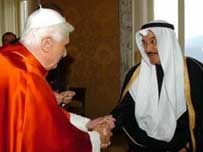
We have not yet arrived at what the Holy Father tries to convey. The point at which he brings the lecture together, linking his critique of the hyper-rationality of the West with the fundamentalistic fideism currently so prevalent in Islam and much of the rest of the developing world, with the former contributing, as a cause, to the latter. It is true that most of the world's 6 billion+ people are religious, even deeply religious. Their cultures and societies derive from their religions. They see the West, quite rightly, as a threat to their ways of life. Therefore, the Holy Father asserts that it is only by overcoming "the self-imposed limitation of reason to the empirically falsifiable" that "we become capable of that genuine dialogue of cultures and religions so urgently needed today. In the Western world it is widely held that only positivistic reason and the forms of philosophy based on it are universally valid. Yet the world's profoundly religious cultures see this exclusion of the divine from the universality of reason as an attack on their most profound convictions. A reason which is deaf to the divine and which relegates religion into the realm of subcultures is incapable of entering into the dialogue of cultures."
W(ittgenstein), back in the late 1920s, issued a devastating critique of this mathematical/empirical principle at which Pope Benedict also takes aim. His critique of this principle arose from his involvement with certain members of the Vienna Circle of logical postivists. Logical positivism is characterized by a so-called scientific world-conception, which has two essential features: "First, it is empiricist and positivist: there is knowledge only from experience." The second feature that marks the scientific world-conception is "the application of a certain method, namely logical [or mathematical]." (in The Legacy of the Vienna Circle: Modern Appraisals by Sarkar and Sahotra, 1996, p. 331). In other words, according to this view, whatever is proposed for belief and justifiably believed must be verified, or, at least, in principle be verifiable (and later, thanks to Popper, also, in principle, falsifiable), either empirically (i.e., through observation), or demonstration by mathematical and/or logical methods (Click here for some background on W).

W's critique consisted of asking, Is the verifiability principle, itself, verifiable? Is the principle that anything that counts as knowledge has to empirically or logically verified, verifiable empirically, logically, or mathematically? For that matter, is it falsifiable by any of these methods? If not, from whence does this criterion derive? It seems that insistence on verifiability and falsifiability is a metaphysical concept. Since it is the whole point of logical positivism to reject metaphysically derived concepts, this critique is difficult, if not impossible to overcome. His Holiness, in his Regensburg lecture, makes the same point.
Making this point about how knowledge is restricted and reduced by the principles of verifiability and falsifiability, constitutes the heart of the Holy Father's critique of the West, which is the main target of his Regensburg lecture, NOT ISLAM. This point got lost in all the hubub over his beginning the lecture by quoting Manuel II Paleologus. What is it that makes this point such a crucial one? Let us turn back to Pope Ratzinger for our answer: "And so I come to my conclusion. This attempt, painted with broad strokes, at a critique of modern reason from within has nothing to do with putting the clock back to the time before the Enlightenment and rejecting the insights of the modern age. The positive aspects of modernity are to be acknowledged unreservedly." His intention "is not one of retrenchment or negative criticism, but of broadening our concept of reason and its application. While we rejoice in the new possibilities open to humanity, we also see the dangers arising from these possibilities and we must ask ourselves how we can overcome them. We will succeed in doing so only if reason and faith come together in a new way, if we overcome the self-imposed limitation of reason to the empirically falsifiable, and if we once more disclose its vast horizons. In this sense theology rightly belongs in the university and within the wide-ranging dialogue of sciences, not merely as a historical discipline and one of the human sciences, but precisely as theology, as inquiry into the rationality of faith."

We have not yet arrived at what the Holy Father tries to convey. The point at which he brings the lecture together, linking his critique of the hyper-rationality of the West with the fundamentalistic fideism currently so prevalent in Islam and much of the rest of the developing world, with the former contributing, as a cause, to the latter. It is true that most of the world's 6 billion+ people are religious, even deeply religious. Their cultures and societies derive from their religions. They see the West, quite rightly, as a threat to their ways of life. Therefore, the Holy Father asserts that it is only by overcoming "the self-imposed limitation of reason to the empirically falsifiable" that "we become capable of that genuine dialogue of cultures and religions so urgently needed today. In the Western world it is widely held that only positivistic reason and the forms of philosophy based on it are universally valid. Yet the world's profoundly religious cultures see this exclusion of the divine from the universality of reason as an attack on their most profound convictions. A reason which is deaf to the divine and which relegates religion into the realm of subcultures is incapable of entering into the dialogue of cultures."
Monday, October 9, 2006
"You will know them by their fruits" Matthew 7,20
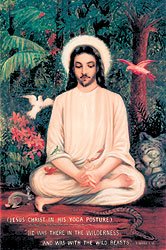
Lest my last post be taken too narrowly, it is important to logically approach some of the conclusions arrived at and axioms accepted in that post in order to explore where such an investigation leads us and to see what difference it makes, or should make, in our lives. Therefore, I wish to point out that if heterodox belief leads to heterodox practice, then orthopraxis flows from orthodoxy, at least to some degree. While I am the first to admit that the two are not point-for-point correlative, there must be some correlation. For example, Jesus tells his disciples, when John reports that the disciples "saw someone casting out demons in your name, and we tried to stop him, because he was not following us", that "whoever is not against us is for us" (Mk 9,38-40).
Of course, as the title of post indicates, it is by a person's actions that we know whether s/he is for Christ the Lord. The New Testament reading that accompanies the reading cited above from St. Mark's Gospel on the Twenty-sixth Sunday in Ordinary Time for Year B of the lectionary cycle, from the second chapter of St. James' letter, tells us, "If a brother or sister has nothing to wear and has no food for the day, and one of you says to them, 'Go in peace, keep warm, and eat well,' but you do not give them the necessities of the body, what good is it? So also faith of itself, if it does not have works, is dead. Indeed someone might say, 'You have faith and I have works.' Demonstrate your faith to me without works, and I will demonstrate my faith to you from my works. You believe that God is one. You do well. Even the demons believe that and tremble." A key point, easily missed in this passage, reads "You believe that God is one. You do well" (Jas 2,19).
It is important to establish, not just a biblical basis for what I want to convey, but a basis in the teaching of Jesus himself. It is easy to find many people who are not only NOT Catholic, but who are not even Christians, who produce good works as a good tree produces good fruits. A wonderful example of this is Mahatma Ghandi, who knew the Gospels and loved the Lord Jesus and very much saw the Lord Jesus as an avatar, the incarnation of a deity, like Vishnu. Now, Ghandi's understanding is not a completely orthodox understanding of the person of Jesus Christ as expressed in Sacred Scripture, or by the Councils of the Church, but neither is it entirely false. Such a view of Jesus certainly led him to produce good fruits. So, let Ghandi serve as a paradigm to show the truth of Jesus' own words that whoever is not against Him is for Him (Matt 12,30; Mk 9,40; Lk 9,5). Once when the missionary E. Stanley Jones met Ghandi he asked him, "Mr. Ghandi, though you quote the words of Christ often, why is that you appear to so adamantly reject becoming his follower?" Ghandi replied, "Oh, I don't reject your Christ. I love your Christ. It's just that so many of you Christians are so unlike your Christ."
Using Ghandi as our paradigm, we can show that God is recognized as One outside the monotheistic faiths (i.e., Judaism, Christianity, and Islam) by the other two great religious traditions, Hindu and Buddhist; the latter of which derives from the former in a manner akin to the way Christianity derives from Judaism. This is made evident in a letter, written by Ghandi to his physician, who was concerned about the amount of fasting Ghandi was doing: "My helplessness is a very patent fact before me. I may not ignore it. I must ever confess it. There is a beautiful Tamil proverb that says: 'God is the sole help of the helpless.' The truth of this never came upon me with much force as it has come today. Handling large masses of men, dealing with them, speaking and acting for them is no joking matter for a man whose capacity God has so circumscribed. One has, therefore, to be ever on the watch. The reader may rest assured that I took the final step after I had realized to the full my utter helplessness. And I cried out to God. That cry must not be from the lip. It has to be from the deepest recesses of one's heart. And, therefore, such a cry is only possible when one is in anguish. Mine has expressed itself in a fast, which is by no means adequate, for the issues involved. My heart continually says: Rock of Ages cleft for me/Let me hide myself in Thee".
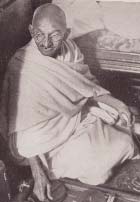
Notice in the excerpt, beside his use of the words of a Christian hymn, Ghandi's constant reference to the One God. Atman is brahman is a Hindu axiom (Hindu being a Western term to describe the religion, comprised of the religions, of the Indian subcontinent), the meaning of this axiom is something close to all is one (and you thought the Hard Rock Cafe was onto something). This, again, is not an orthodox Christian understanding of Being, but, as with Ghandi's understanding of the person of Jesus Christ, it contains a deep Truth. Truth is a unified whole and, by its nature, is universal. All is one, however, is pantheism. Christianity rejects pantheism because we see God as separate from and greater than His creation. However, the unity recognized and longed for in the axiom atman is brahman comes to close to what Jesus prays for in His great high priestly prayer, found in St. John's Gospel. In this passage, Jesus prays to His Father: "I ask not only on behalf of these, but also on behalf of those who will believe in me through their word, that they may all be one. As you, Father, are in me and I am in you, may they also be in us, so that the world may believe that you have sent me. The glory that you have given me I have given them, so that they may be one, as we are one, I in them and you in me, that they may become completely one, so that the world may know that you have sent me and have loved them even as you have loved me " (Jn 17,20-23).
The unity for which our Lord prayed is achieved most visibly, most concretely and actually in and through the eucharistic sacrifice. "For the liturgy, through which the work of our redemption is accomplished" we are told in Vatican Council II's Constitution on the Sacred Liturgy, Sacrosanctum Concilium, "most of all in the divine sacrifice of the eucharist, is the outstanding means whereby the faithful may express in their lives, and manifest to others, the mystery of Christ and the real nature of the true Church. It is of the essence of the Church that she be both human and divine, visible and yet invisibly equipped, eager to act and yet intent on contemplation, present in this world and yet not at home in it; and she is all these things in such wise that in her the human is directed and subordinated to the divine, the visible likewise to the invisible, action to contemplation, and this present world to that city yet to come, which we seek. While the liturgy daily builds up those who are within into a holy temple of the Lord, into a dwelling place for God in the Spirit, to the mature measure of the fullness of Christ, at the same time it marvelously strengthens their power to preach Christ, and thus shows forth the Church to those who are outside as a sign lifted up among the nations under which the scattered children of God may be gathered together, until there is one sheepfold and one shepherd."
The late theologian, Fr. Jaques DuPuis, S.J., who taught theology in India for over thirty years, and then at Rome's Pontifical Gregorian University, wrote in his wonderful book, Christianity and the Religions: From Confrontation to Dialogue, "the New Testament is not about one people of God being replaced by another, but about the expansion of the people of God beyond its own limits through the extension of the church . . . to the nations." Fr. DuPuis was called-on-the-carpet in his later years by the Congregation for the Doctrine of the Faith for his book Toward a Christian Theology of Religious Pluralism, which was not condemned, or corrected, but merely recognized as a work of advanced theology that, by its very nature, contains ambiguities.
Nonetheless, this calling-into-question of his fidelity caused him great pain. In Christianity and the Religions he wrote that, in the wake of Vatican II's Declaration on the Relation of the Church to Non-Christian Religions, entitled Nostra Aetate (which I urge anybody reading this to read in its entirety- it's short), "No longer does it suffice to ask whether and what religious traditions have to do with the mystery of the salvation of their adherents in Jesus Christ. More positively and profoundly, the question is what positive meaning the religious traditions themselves have in God's single overall plan of salvation. Without a pretense of being able to fully discern the divine plan for humankind, the question is nevertheless posed of whether the religious pluralism in our world today, as was once thought spontaneously - not without some negative prejudices against the religious traditions - that all men are destined by God to become explicitly Christians, even if most of them do not reach this destiny of theirs, while the reality in which we are living seems to indicate just the opposite? Is not God perhaps 'greater than our hearts (1 Jn 3,20) ["for God is greater than our heart and knows all things"] - and his plan of salvation larger than our theological ideas?" In other words, like Immanuel Kant, who asked in his Critique of Pure Reason, not whether human beings can know, but how we know, Fr. DuPuis asks not whether non-Christian religions positively contribute to the salvation of their adherents, which is always the salvific work of Christ, especially through the eucharist, but how these religions positively contribute to the salvation of adherents, a salvation that God desires for everyone (1 Tim 2,3-4). So, just how God accomplishes "the work of our redemption" in and through the eucharistic sacrifice is mysterious. This sacrifice is effacacious for the redemption of humanity, but it often works in unseen ways, as Fr. DuPuis indicates.

Our faith is not a box we put ourselves into to shrink the world down to a size we can deal with and more easily comprehend. Neither is faith a shielded corner into which God consigns us. Faith in Christ, which is a gift from God, is a vista that gains us a bigger and more breath-taking view that opens up the mystery of Being, from whence we get a broader view of God's awful (meant in the sense of full of awe, not "bad") and beautiful creation. As dear Frater Tom (Merton) puts it, "If I affirm myself as a Catholic merely by denying all that is Muslim, Jewish, Protestant, Hindu, Buddhist, etc., in the end I will find that there is not much left for me to affirm as a Catholic: and certainly no breath of the Spirit with which to affirm it."
A far too simplistic overview of various major Christian theological anthropologies
How's that for a title to a post! Anyway, I received some questions on a class I taught yesterday on the Spiritual Disciplines, the answers to which I think may be beneficial to others beside the very astute questioner. The fundamental issue derived from my statement in class that we understand ourselves as enfleshed souls. We do not possess souls, we are souls. We do not possess bodies, we are bodies. There is not way to draw a precise line between the two. So much are we enfleshed souls, which I am using a bit imprecisely as being synonymous with spirit, that we will exist as such for ever because, according to our shared Credo, we believe in the resurrection of the body AND in life eternal.
If we make a hard and fast distinction between soul and body, with an eye toward separating them completely, we will wind up with some form of gnostic understanding, a heterodox belief, which will lead to heterodox practices. Whenever we discuss gnosticism, we must keep in mind, as Msgr M. Francis Mannion, a mentor and a man I deeply admire and without whom I would not be a deacon, writes in one of his Pastoral Answers columns for Our Sunday Visitor : "Gnosticism is such a complex reality with so many expressions that I can only give you a general description". As to the spiritual vs. the material, an opposition any healthy theology seeks to overcome and integrate, constitutes the very heart of the various gnostic ontologies, Msgr. Mannion writes, "The Gnostic sects thought the universe to be fundamentally evil. The end of all things was the overcoming of the grossness and depravity of the material and created order and the return of the soul to the Spirit-Parent facilitated by some God-sent savior. In that sense the Gnostics were pessimistic about the world", including, I might add, human beings. Again, universal among the gnostics, Christian, non-Christian, and pre-Christian, were the beliefs that spirit and matter are separable and that spirit is superior is matter. Their practices, flowing from their beliefs, were designed to liberate the spirit from the body. The goodness of material creation is essential for a sacramental view of the world.
This brings us to Christianity and the issue of total depravity. The Calvinistic doctrine that tells us, because of the fall, we are capable of no good apart from God. In other words, humanity is totally depraved. This is a major Protestant theology, which has different iterations. That is what makes my treatment far too simplistic. The belief in the total depravity derives from the theology of John Calvin, and is also called Reformed theology, which is on the rise in the U.S. these days. Reformed theology is the major influence among Presbyterians and Baptists, among other Christian denominations.
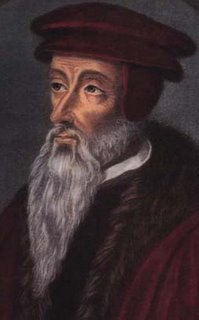 In the U.S. it is the strongest theological current flowing through the Southern Baptist Convention, though there are Southern Baptists who are not Calvinistic. Due to the sway Calvinism has held over Protestantism in the U.S, it remains pervasive within Evangelical Christianity in the U.S. However, most evangelicals are not very theological and do not even attempt a systematic approach. So, the current of Calvinism becomes something of an undercurrent. Arguably, the health and wealth gospels are highly distorted forms of Reformed theology.
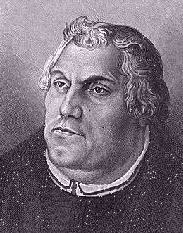
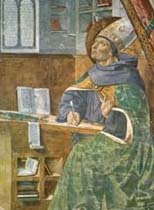
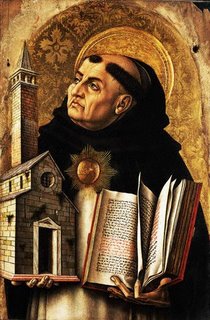
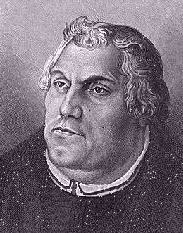
The other significant strand of Protestant theology for my far too simplistic purpose in this post is that of Martin Luther. It is more positive toward the human person than is Calvinism, but less so than Catholics in general, who largely take our cue from St. Thomas Aquinas. It is also important to note that among Catholics there are different theologies as well. The two major strains take find their roots in Augustine and Thomas Aquinas respectively. Since Luther, while a Catholic priest, was an Augustinian friar, it is not surprising that the Lutheran view of the human person is a variety of Augustinianism.
Martin Luther
Popes John Paul II and Benedict XVI gives us a ready-made example of the distinction between Thomism and Augustinianism, with John Paul II being a Thomist, thus having a more positive view of fallen humanity, while Benedict is more of an Augustinian, which is more pessimistic about people in terms of the basic goodness of fallen humanity.
This difference is not due to any substantial disagreement between these two good friends and collaborators. In fact, the differences are complementary.
The difference probably arises from the fact that one is a Philosopher (John Paul II) and one is a theologian (Benedict XVI), as well as their cultural differences and their personal experiences in and of the world. In the end, neither Augustinians, including Lutherans, nor Thomists hold to total depravity as Calvinists and other Reformed theologies, theologians, and believers do.
It is important to get this right in order to live our lives in right manner, according to right reason. Orthodoxy=right belief or purity of faith and orthopraxis=right practice are inevitably linked. How we conceive of God, ourselves, each other, and the world matter tremendously. For these conceptions comprise the basis on which we live. We must also avoid the pitfall of thinking we know everything, or even thinking that we know and have experienced all we need to know and experience. We are and will remain beginners, mere children, but of a loving Father. Far from discouraging, this should encourage us, that is, give us the courage to walk with God. As beginners, we must begin. This far too simplistic overview, along with yesterday's class, constitute one small, but important, step. As Archbishop Donald Coggan, the 101st Archbishop of Canterbury, as quoted by Richard Foster in Celebration of Discipline, wrote: "I go through life as a transient on his way to eternity, made in the image of God but with that image debased, needing to be taught how to meditate, to worship, to think".
Based on all the above, I offer a prayer for today, inspired by Archbishop Coggan's remark and verses 1 and 2 of the twelfth chapter of St. Paul's letter to the Romans:
Lord, renew your image that is within us. Teach us how meditate in your holy presence, to worship you and you alone, not the idols fashioned by our actions and imaginations. Teach us to think by renewing our minds, that we may discern your will-what is good and acceptable and perfect, that we may present our bodies, which comprise your mystical Body, the Church, as living sacrifices, holy and acceptable to you, our spiritual worship. (see Romans 12,1-2).
If we make a hard and fast distinction between soul and body, with an eye toward separating them completely, we will wind up with some form of gnostic understanding, a heterodox belief, which will lead to heterodox practices. Whenever we discuss gnosticism, we must keep in mind, as Msgr M. Francis Mannion, a mentor and a man I deeply admire and without whom I would not be a deacon, writes in one of his Pastoral Answers columns for Our Sunday Visitor : "Gnosticism is such a complex reality with so many expressions that I can only give you a general description". As to the spiritual vs. the material, an opposition any healthy theology seeks to overcome and integrate, constitutes the very heart of the various gnostic ontologies, Msgr. Mannion writes, "The Gnostic sects thought the universe to be fundamentally evil. The end of all things was the overcoming of the grossness and depravity of the material and created order and the return of the soul to the Spirit-Parent facilitated by some God-sent savior. In that sense the Gnostics were pessimistic about the world", including, I might add, human beings. Again, universal among the gnostics, Christian, non-Christian, and pre-Christian, were the beliefs that spirit and matter are separable and that spirit is superior is matter. Their practices, flowing from their beliefs, were designed to liberate the spirit from the body. The goodness of material creation is essential for a sacramental view of the world.
This brings us to Christianity and the issue of total depravity. The Calvinistic doctrine that tells us, because of the fall, we are capable of no good apart from God. In other words, humanity is totally depraved. This is a major Protestant theology, which has different iterations. That is what makes my treatment far too simplistic. The belief in the total depravity derives from the theology of John Calvin, and is also called Reformed theology, which is on the rise in the U.S. these days. Reformed theology is the major influence among Presbyterians and Baptists, among other Christian denominations.
John Calvin
The other significant strand of Protestant theology for my far too simplistic purpose in this post is that of Martin Luther. It is more positive toward the human person than is Calvinism, but less so than Catholics in general, who largely take our cue from St. Thomas Aquinas. It is also important to note that among Catholics there are different theologies as well. The two major strains take find their roots in Augustine and Thomas Aquinas respectively. Since Luther, while a Catholic priest, was an Augustinian friar, it is not surprising that the Lutheran view of the human person is a variety of Augustinianism.
Martin Luther
Popes John Paul II and Benedict XVI gives us a ready-made example of the distinction between Thomism and Augustinianism, with John Paul II being a Thomist, thus having a more positive view of fallen humanity, while Benedict is more of an Augustinian, which is more pessimistic about people in terms of the basic goodness of fallen humanity.
St. Augustine

This difference is not due to any substantial disagreement between these two good friends and collaborators. In fact, the differences are complementary.

The difference probably arises from the fact that one is a Philosopher (John Paul II) and one is a theologian (Benedict XVI), as well as their cultural differences and their personal experiences in and of the world. In the end, neither Augustinians, including Lutherans, nor Thomists hold to total depravity as Calvinists and other Reformed theologies, theologians, and believers do.
It is important to get this right in order to live our lives in right manner, according to right reason. Orthodoxy=right belief or purity of faith and orthopraxis=right practice are inevitably linked. How we conceive of God, ourselves, each other, and the world matter tremendously. For these conceptions comprise the basis on which we live. We must also avoid the pitfall of thinking we know everything, or even thinking that we know and have experienced all we need to know and experience. We are and will remain beginners, mere children, but of a loving Father. Far from discouraging, this should encourage us, that is, give us the courage to walk with God. As beginners, we must begin. This far too simplistic overview, along with yesterday's class, constitute one small, but important, step. As Archbishop Donald Coggan, the 101st Archbishop of Canterbury, as quoted by Richard Foster in Celebration of Discipline, wrote: "I go through life as a transient on his way to eternity, made in the image of God but with that image debased, needing to be taught how to meditate, to worship, to think".
Based on all the above, I offer a prayer for today, inspired by Archbishop Coggan's remark and verses 1 and 2 of the twelfth chapter of St. Paul's letter to the Romans:
Lord, renew your image that is within us. Teach us how meditate in your holy presence, to worship you and you alone, not the idols fashioned by our actions and imaginations. Teach us to think by renewing our minds, that we may discern your will-what is good and acceptable and perfect, that we may present our bodies, which comprise your mystical Body, the Church, as living sacrifices, holy and acceptable to you, our spiritual worship. (see Romans 12,1-2).
Friday, October 6, 2006
I'll have the filet o' fish with no tartar sauce, please.
 In November 1966, on the heels of Pope Paul VI's Apostolic Constitution, Paenitemini, in which Paul proposed to renew "penitential discipline with practices more suited to our times", the United States Conference of Catholic Bishops set forth a Pastoral Statement on Penance and Abstinence. This statement by the U.S. Bishops still constitutes the normative application of the Holy See's directive for Catholics in the United States. Today being Friday, let us explore this a little and see what fruit it bears.
Some preliminary notes are required before wading in to what our bishops teach. In the early Church, Sunday was the day on which Christ's Resurrection was celebrated. Of course, it remains so today and has throughout the Church's entire history, but even observing Sunday as the Lord's Day seems to be imperiled (see Pope John Paul II's Dies Domini). Appropriately, elements of the Jewish Sabbath are observed by faithful Christians on Sunday, the Lord's Day, just as Christian fasting finds its roots in Jewish practice. Another early Christian observance, in addition to the little Easter of each Sunday, was a little Good Friday, a memorial of the day on which Christ died for us. While we feast on the resurrection, we fast and abstain in solidarity with Christ's suffering as an act of penance and solidarity with each other and those who suffer, on the crucifixion.
Fasting is one of many ascetical practices that is currently poorly understood and, hence, little practiced. Ascetical is derived from the Greek word askesis, which means "exercise, training, discipline." This is the kind of thing St. Paul is writing about in passages from his letters, like 1 Corinthians 9,24b-27, in which he writes: "Do you not know that the runners in the stadium all run in the race, but only one wins the prize? Run so as to win. Every athlete exercises discipline in every way. They do it to win a perishable crown, but we an imperishable one. Thus I do not run aimlessly; I do not fight as if I were shadowboxing. No, I drive my body and train it, for fear that, after having preached to others, I myself should be disqualified." The ascetical life, writes Fr. Thomas Ryan, CSP, in his book The Sacred Art of Fasting: Preparing to Practice, "is either the project of appropriating the divine gift of grace or, more frequently, the work of purification." He continues in his recovery of the word ascetic by stating that ascetical "practices are methods designed to restrain the influence of sin and maximize union with God". If there is one area of the work of Richard Foster and Dallas Willard, both of whom I admire very much, I take issue with, it is their unbending criticism of asectism, seeing it and writing about it as if it were a dirty Catholic word. Just as many evangelical Christians devalue the word religion, so too with ascetism- those nasty old practices of monks and nuns in the Dark Ages, that are a distortion of Christ's teachings. Nothing could be further from the truth, as Foster's and Willard's work goes on to show.
Fr. Charles Cummings, O.C.S.O of Holy Trinity Abbey in Huntsville, Utah (just a little North of me, a community that has nurtured and strengthened me over many years), writes in his book
Monastic Practices, as quoted by Fr. Ryan, "The more I try to make Christ the center of my life and thoughts and actions, the more I feel every pull and tug that draws me back from the radical, loving surrender of myself. I am not totally free to run toward the one I love. Instead, I feel enchained, entangled by a thousand little threads that together form a strong rope binding me to myself. Detaching myself from these bonds is largely a matter of self-discipline and asceticism. Paradoxically, [the spiritual life is fraught with paradox]self-discipline sets me free for God. Self-discipline is a training in freedom. I am free to take something comfortable and pleasurable, or to eat and drink more, or to sleep longer, but I am also free to refrain from these things and not let myself be held bound by them" (bracketed words are mine).
I hope that lays a little necessary groundwork before returning to the issue of Fridays as penitential days. Last Friday I quoted from a recent document by the U.S. Bishops on penitential practices and provided a link to their pamphlet. Today I want to return to that point in time when Friday abstinence from meat was rescinded as a requirement of Church law in order to show that what the bishops, and the Pope, were hoping for was for Catholics to freely enter into Fridays with a renewed fervor, not to abandon penitential practices altogether. With no further adieu, let us see what we have been taught.
"Christ died for our salvation on Friday," begins the 1966 statement. "Gratefully remembering this, Catholic peoples from time immemorial have set apart Friday for special penitential observance by which they gladly suffer with Christ . . . Since the spirit of penance primarily suggests that we discipline ourselves in that which we enjoy most, to many in our day abstinence from meat no longer implies penance, while renunciation of other things would be more penitential." We might well ask, What other things? Here are few suggestions, alcohol, television and movies, desserts, or, for married couples, by mutual agreement, sex. Those are just for starters, try giving up one of those things, thus whittling away at the threads of the rope that binds us, as described by Fr. Charles. Do these things with prayer and almsgiving. As an example, if you typically spend $10 or $20 having a few cocktails on Friday, give that money to the poor. Fasting and abstinence undergird prayer and almsgiving, these practices do not replace them. In fact, fasting and abstinence are incomplete without praying and giving because the practice, the discipline, is not an end in and of itself, is a means to an end- loving God and neighbor.
"For these and related reasons, the Catholic bishops of the United States, far from downgrading the traditional penitential observance of Friday, and motivated precisely by the desire to give the spirit of penance greater vitality, especially on Fridays, the day that Jesus died, urge our Catholic people henceforth to be guided by the following norms.
"Friday itself remains a special day of penitential observance throughout the year . . . Friday should be in each week something of what Lent is in the entire year. For this reason we urge all to prepare for that weekly Easter that comes with each Sunday by freely making of every Friday a day of self-denial and mortification in prayerful remembrance of the passion of Jesus Christ. . . Among the works of voluntary self-denial and personal penance which we especially recommend to our people . . . we give first place to abstinence from flesh meat. We do so in the hope that the Catholic community will ordinarily continue to abstain from meat by free choice as formerly we did in obedience to Church law . . . Our deliberate, personal abstinence from meat, more especially because no longer required by law, will be an outward sign of inward spiritual values" [sounds quite sacramental...hmmm].
The bishops continue, "Fridays, please God, will acquire among us other forms of of penitential witness which may become as much a part of the devout way of life in the future as Friday abstinence from meat . . . Let it be proved by the spirit in which we enter upon prayer and penance, not excluding fast and abstinence freely chosen, that these present decisions and recommendations of this conference of bishops will herald a new birth of loving faith and a more profound penitential conversion, by both of which we become one with Christ, mature sons and daughters of God, and servants of God's people".
All emboldened words are my emphasis. So, this Friday let us ask ourselves, how are we doing? How well are we exercising our freedom as children of God in Christ by virtue of our baptism? Are we achieving the maturity that God, through the Church, calls us to, or are we still children waiting to have rules imposed on us? Are we lazy, waiting to grow spiritually with no effort? Would we expect to be able to run a marathon, play professional sports, build a beautiful table, with no training or effort? Just a few questions to ponder.
Thursday, October 5, 2006
St. Francis and the Sultan
St. Francis before the Sultan
 There is considerable uncertainty as to the chronological and historical details of the last fifteen years of the life of St. Francis of Assisi. Among the events of these years was the first attempt at a mission to Muslims. Brother Francis sent five brothers, soon to be martyrs, to Morocco. He also undertook, himself, a journey to Spain. But, illness forced him to return without accomplishing his objective, which was the establishment of his order of friars on the Iberian peninsula and in France.
One interesting note for today, when, in the light of the Holy Father’s Regensburg lecture, relations between Christians and Muslims are center stage, is St. Francis’ journey to Egypt and Palestine. This occurred during the Crusades and was undertaken with the intention of converting the Sultan Kameel and bringing fighting to an end. To this end, Francis gave fearless proofs of his readiness to suffer for his faith. Upon his return to Italy, in 1220, he found the Franciscans in discord. In response to this disorder within his order, with a broken heart, he issued his second, expanded, rule, which was replaced two years later by the revised rule, drawn up by Cardinal Ugolino, which Francis reluctantly accepted out of obedience.
For a Franciscan perspective on Francis' journey to Egypt and its relevance now, please follow the link to Fr. Jack Wintz, OFM’s St. Francis, the Sultan and the Quest for Peace.
Wednesday, October 4, 2006
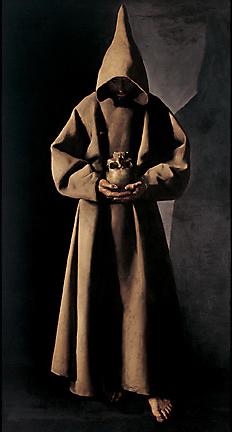
Twenty-sixth Wednesday in Ordinary Time: Memorial of St. Francis of Assisi
 Readings: Jb 9,1-12.14-16; Ps 88,10-15; Lk 9,57-62
Below is an excerpt from my homily for today's Memorial of St. Francis of Assisi. Even more than when speaking or writing about Pater/Frater Tom, when it comes to St. Francis mere words could never express my feelings, or the impact this great saint has had on me. I am not alone. Another person whose life was deeply affected and influenced by Francesco Bernadone is Chiara Offreduccio, better known as St. Clare.
Among the saints of the Church, Francesco Bernadone is easily the most recognizable and best loved. He is seen as something of a patron for environmentalists and peace movement activists. To a certain degree this is fine and well. But to restrict or reduce this great man to only that is to miss the fundamental meaning of his life. He was a man who was wholly transformed, through God's gratuitous action, into the image of Christ.
In a letter, written in August, Pope Benedict XVI wrote about St. Francis to the current bishop of the Diocese of Assisi. In his letter the Holy Father said, "He was not merely an environmentalist or a pacifist. He was, above all, a converted man." His conversion to Jesus Christ, for whose sake St. Francis "made a 'radical choice' and from there gradually came to understand what it meant to 'rebuild the house of the Lord,'" makes him, according to Benedict, a model of conversion and holiness who is "more valid than ever for today's Church."
After his conversion, St. Francis, like Jesus himself in today's Gospel, began to draw followers. These would be disciples, or Franciscans, like the first man in today's Gospel who says he wants to follow the Lord, were met with the reply that to follow meant, literally, giving up everything to rely only on God who, through the generosity of others, would provide for all their needs. It is easy to forget that St. Francis was not a priest. He was ordained a deacon because, as a loyal son of the Church, our mater et magistra, he wanted to preach licitly in Churches and in the name of the Church.
Like all holy men and women, St. Francis suffered. He suffered at the hands of his own followers, dying outside the Franciscan order. He suffered in the early days following his conversion from ridicule and abuse heaped on him by former friends and the people of Assisi, who thought he had gone crazy. As we all know, he was led by the Lord to the little, dilapidated Church of San Damiano, where, while praying before the crucifix, he was told by the Lord "Rebuild my Church." True to his trusting and childlike nature, which was a gift of his conversion, part of his transformation from a worldwise playboy and would-be merchant, he obeyed literally by rebuilding San Damiano and restoring it with his own hands. More significantly he rebuilt a Church badly in need of reform by his poverty, chastity, obediance and overall evangelical zeal, all motivated by love. Along with his contemporary, St. Dominic, he was instrumental in bringing about a revival in the Church by the breath of God, the Holy Spirit.
St. Francis accepted all the suffering, be it physical, mental, or spiritual, that came his way as a privileged channel through which, in imitation of our Lord and Savior, he was made perfect, even receiving in his own body the wounds of Christ. With genuine humility, Francis felt himself unworthy to bear the wounds of Christ and always sought to hide them, with many close to him not knowing that he had received the stigmata until he died.
May we, like St. Francis of Assisi, heed the call of Christ on our own lives, setting our hand to the plow and not looking back, in order that we may be fit, by grace, for God's Kingdom. May we be true heralds of the Kingdom God, preaching the Gospel and using words only when necessary. Christian singer-songwriter Michael Card captures the spirit of St. Francis perfectly in his song God's Own Fool: "So come lose your life for a carpenter's Son/For a madman who died for a dream/Then you'll have the faith his first followers had/And you'll feel the weight of the beam/So we follow God's own fool/For only the foolish can tell/Believe the unbelievable/Come be a fool as well".
Subscribe to:
Posts (Atom)
Feast of the Exaltation of the Holy Cross
Readings: Numbers 21:4b-9; Psalm 78:1-2.34-38; Philippians 2:6-11; John 3:13-17 Today the Church throughout the world celebrates the Feas...

-
It is time to introduce yet another member of my community of the heart. Yesterday I mentioned that the theology of Hans Urs von Balthasar w...
-
Recently I have been asked several times about remarriage and the permanent diaconate. In the present state-of-affairs, which may eventually...
-
 Because my parish celebrated Mass in the evening instead of in the morning today, I was able to assist my pastor at the altar on this Memori...
