Monday, October 16, 2006

Overcoming hatred with love on the feast of Diwali

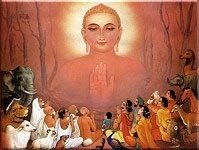
This Saturday, 21 October, marks the feast of Diwali. The word Diwali is derived from the Sanskrit Deepavali and refers to the earthen lamps that people place around their homes as part of the observance of this feast. For the Hindu faithful, the light from the lamps "represent," according to Candace Murphy, whose article on the feast appears on the website of the Hindu American Foundation, "the dispelling of ignorance, and the illumination of truth."

Diwali falls on the 15th day of the dark fortnight of the Hindu month of Kartik, or the last day of the last month in the lunar calendar. Hence, as with all lunar holidays, like Easter, it does not fall on the same day of the solar calendar from year-to-year. In addition to being a celebration among Hindus, Diwali is also observed by Sikhs and Jains. The significance of the feast for Sikhs is a celebration of "the release of the Sixth Guru, Hargobind, from captivity by the Mughal Emperor Jehangir." Jains, meanwhile, commemorate Diwali as the day Lord Mahavira, the last of the Tirthankaras, attained Nirvana after his death in 527 BC.

All this is a lead-in to the statement issued today at the Vatican, by Paul Cardinal Poupard, president of the Pontifical Council for Inter-religious Dialogue, to Hindus (Why not Sikhs and Jains? I do not know). The title of the message is Overcoming Hatred with Love. The core of Cardinal Poupard's message is found in this paragraph:

"God loves us all without exception and his love is unconditional. Our human response to God’s love must be spelt out in concrete stewardship of God’s creatures, especially to human beings. It is urgent and necessary that believers of different religions manifest jointly to the world that hatred can be overcome by love. In today’s complex societies, is it not possible for us to join hands and collaborate in seeking justice for all, working together on common projects, for the development of the downtrodden, the marginalized, the destitute, the orphan and the weak? 'Despite the great advances made in science and technology, each day we see how much suffering there is in the world on account of different kinds of poverty, both material and spiritual' (Deus caritas est, n. 30). Moral and spiritual poverty, which are caused by breeding hatred in one’s heart, can be eradicated by believers who are filled with love and compassion. Love creates trust, which in turn, promotes genuine relationships among believers of different religions."

In his message from a previous year, Archbishop Michael Fitzgerald, Cardinal Poupard's predecessor, now Papal nuncio to Egypt, wrote in one his Diwali messages:
"You will agree with me in recognizing that one of the purposes of religious feasts is to make us better human persons. During the season of Diwali, as you strive to overcome darkness through light, evil through goodness and hatred through love, I would like to propose to you, as one of your Christian friends, that we focus our attention on the evils in our society that afflict children: forced labor, forced conscription, break down of the family, trafficking in organs and persons, sexual abuse, forced prostitution, AIDS, the sale and use of drugs, etc."

Saturday, October 14, 2006

Catholic Heaven, Simpsons style

Sticking with Calvin's dictum (the little boy from Calvin and Hobbs, not John Calvin, Protestant Reformer), that if something is funny once, it's funny a thousand times, I felt compelled to track down a clip from the same episode of The Simpsons in which Liam Neeson guest stars as Fr. Sean, that shows a very Catholic conception of heaven. Again, enjoy and laugh. I am quite certain that is what Jesus would have us do. Just to avoid confusion, not to insult anybody's intelligence, the Protestant reformation began on 31 October 1517, when the Augustinain friar, Martin Luther, nailed his 99 theses to the door of the Church in Wittenberg. Of course, there were prescursors and follow-on movements, just none at Lourdes over wet hair in Church. Also, contra Reverend Lovejoy, theologically-speaking, there is only one heaven and, while there will, please God, be many Catholics, many non-Catholics will be there, too. Let's invite everyone to join the fun.


Things Contemporary: Homer Simpson ponders the mysterium fidei

Since this blog is also "a place for me to muse about things contemporary", I direct you to Dawn Eden's wonderful blog, The Dawn Patrol. Dawn, along with Rocco Palmo over at Whispers in the Loggia, muses about things contemporary more and better than I do. This is probably because they're both younger and more hip than I am- no surprise there! Rocco writes about his contemporary musings a bit on Whispers, he does so mostly in his column, Almost Holy, over at Busted Halo, a great Catholic website run by the Paulists, who I revere every bit as much as I do the children of Sts. Francesco and Chiara. If I were looking for a religious order to join, it would be difficult to decide between the Franciscan Friars of the Renewal and the Missionary Society of St. Paul the Apostle.

Among the many things I enjoy about reading Dawn, a recent convert to the Catholic faith, apart from her ability to write compelling, is her on-going and very personal engagement with the work of G.K. Chesterton, for whose beatification I urge everybody to pray. As an example, in a posting yesterday, Dawn quotes Chesterton on virtue in general and on the virtue of chastity in particular, from Chesterton's essay A Piece of Chalk. With all due credit to Dawn for retrieving this precious gem, read away!

"Virtue is not the absence of vices or the avoidance of moral dangers; virtue is a vivid and separate thing, like pain or a particular smell. Mercy does not mean not being cruel, or sparing people revenge or punishment; it means a plain and positive thing like the sun, which one has either seen or not seen.

"Chastity does not mean abstention from sexual wrong; it means something flaming, like Joan of Arc."


Since this posting is entirely a Saturday morning digression, I urge you over to Dawn's excerpt from an episode of The Simpons, featuring Liam Neeson as Father Sean, in which Homer goes to bawl Fr. Sean out for making Bart want to become Catholic and winds up being convinced himself. So, link over to Homer to Rome, read the dialogue and enjoy!

Friday, October 13, 2006

As the sun goes down, a singer and a song to bring Friday to a close

Day is Done

Day is done, but love unfailing
dwells ever here
Shadows fall, but hope, prevailing,
calms every fear.
God, our Father, none forsaking,
take our hearts of Love's own making
Watch our sleeping, guard our waking,
be always near.


Dusk descends, but light unending
shines through our night
You are with us, ever lending
new strength to sight
One in love, your truth confessing
one in hope of heaven's blessing
May we see, in love's possessing
love's endless light!

Eyes will close, but you unsleeping
watch by our side
Death may come, in love's safekeeping
still we abide
God of love, all evil quelling
sin forgiving, fear dispelling
Stay with us, our hearts indwelling
this eventide.

As this day of penance and recollection- recollecting what Christ did for us on the Cross- ends, let us to turn the Scripture, specifically to St. James' Letter, chapter 4, verses 7-10: "Submit yourselves therefore to God. Resist the devil, and he will flee from you. Draw near to God, and he will draw near to you. Cleanse your hands, you sinners, and purify your hearts, you double-minded. Lament and mourn and weep. Let your laughter be turned into mourning and your joy into dejection. Humble yourselves before the Lord, and he will exalt you."

Thursday, October 12, 2006

Friday is almost here, are you hungry for God?

As readers know, one of my main exhortations on this blog, a pet peeve, if you will, is Friday as a day of penance, just as Sunday is a day of celebration: Good Friday and Easter Sunday. To that end, I direct the curious toward my previous posts on this subject, one from last Friday and the other from Friday, 29 September. Since, liturgically, Friday begins at sundown this evening and ends at sundown tommorrow, it is time to think about a fast of some kind, charitable works and almsgiving to accompany fasting, or other works of penance. We have plenty of suggestions from our bishops, that are derived from Sacred Tradition. Along with charitable works and almsgiving, spiritually motivated fasting also requires prayer. But the relationship is fasting undergirds, supports and sustains prayer and almsgiving.

Let us take our inspiration and get our motivation from our Lord Himself by reading Matthew, chapter 6. Here are few salient excerpts from this chapter:

Almsgiving
verse 2- "When you give alms, do not blow a trumpet before you, as the hypocrites 2 do in the synagogues and in the streets to win the praise of others. Amen, I say to you, they have received their reward."

Prayer
verses 7-14- "In praying, do not babble like the pagans, who think that they will be heard because of their many words. Do not be like them. Your Father knows what you need before you ask him. 'This is how you are to pray: Our Father in heaven, hallowed be your name, your kingdom come, your will be done, on earth as in heaven. Give us today our daily bread; and forgive us our debts, as we forgive our debtors; and do not subject us to the final test, but deliver us from the evil one. If you forgive others their transgressions, your heavenly Father will forgive you.'"

Fasting
verses 17-18 - "But when you fast, anoint your head and wash your face, so that you may not appear to be fasting, except to your Father who is hidden. And your Father who sees what is hidden will repay you."

The Reason/The Why
Why? verses 19-21 - "Do not store up for yourselves treasures on earth, where moth and decay destroy, and thieves break in and steal. But store up treasures in heaven, where neither moth nor decay destroys, nor thieves break in and steal. For where your treasure is, there also will your heart be."

As Friday approaches, let us ask ourselves, Where is our treasure? What really matters to us?

Observing the gap through a literary prism

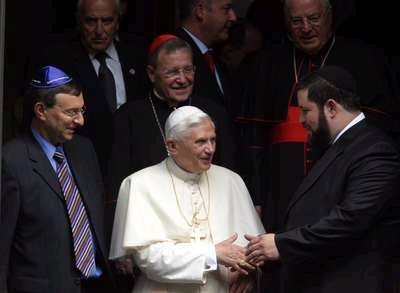
Today, which marks the one month anniversary of Benedict XVI’s Regensburg lecture, the Pope received, at the Vatican, a group from the Anti-Defamation League (ADL). This Jewish organization, which was founded in 1913, aims at stopping the defamation of the Jewish people through appeals to reason and conscience and, when necessary, by appeals to law. Addressing the group in English, Pope Benedict, according to the Vatican Information Service, said to members of the ADL:

"In our world today religious, political, academic and economic leaders are being seriously challenged to improve the level of dialogue between peoples and between cultures. To do this effectively requires a deepening of our mutual understanding and a shared dedication to building a society of ever greater justice and peace. We need to know each other better and, on the strength of that mutual discovery, to build relationships not just of tolerance but of authentic respect. Indeed, Jews, Christians and Muslims share many common convictions, and there are numerous areas of humanitarian and social engagement in which we can and must cooperate.
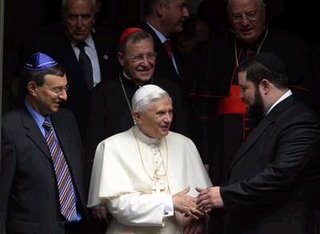
"The Vatican Council II Declaration Nostra Aetate reminds us that the Jewish roots of Christianity oblige us to overcome the conflicts of the past and to create new bonds of friendship and collaboration. It affirms in particular that the Church deplores all forms of hatred or persecution directed against the Jews and all displays of anti-Semitism at any time and from any source."

These remarks, neither accidentally, nor incidentally, bear close resemblance to the core of his remarks at Regensburg last month. Today's remarks hearken back to the core of the Regensburg lecture, about which I posted earlier this week. It is certainly worth re-posting this core statement, in which the Holy Father prescinds from the fact that the vast majority of the earth’s over 6 billion people are deeply religious and that their cultures and societies are deeply rooted in their religions. These religions comprise the five great traditions, which, chronologically are: Hindu, Buddhist, Judaism, Christianity, and Islam. Many of these peoples, Eastern Christians included, view the West and its secularizing and immoralizing reach as a threat to their ways of life. It is this false gap that has developed between faith and reason Pope Benedict seeks to bridge when he said in his lecture last month that the West must overcome "the self-imposed limitation of reason to the empirically falsifiable" that "we become capable of that genuine dialogue of cultures and religions so urgently needed today. In the Western world it is widely held that only positivistic reason and the forms of philosophy based on it are universally valid. Yet the world's profoundly religious cultures see this exclusion of the divine from the universality of reason as an attack on their most profound convictions. A reason which is deaf to the divine and which relegates religion into the realm of subcultures is incapable of entering into the dialogue of cultures."

In order to make some links between posts on this blog and, hopefully, bring some coherence to various observations, I offer a passage from Turkish author, Orhan Pamuk’s novel, Snow, which I recommended in my post Middle Eastern Sources, as a case-in-point from literature, which is a privileged gateway into any culture, of what the Holy Father is trying to communicate to the secularized and increasingly irreligious West. I read this last evening and was struck by how well Pamuk captures this real, but unnecessary, tension that seems to be rending the world apart. In an arguable case of synchronicity, just as I was typing this, at 10:16 am, I learned that Pamuk has been awarded this year’s Noble Prize for Literature, an honor richly deserved.

In this dialogue, from Snow, Pamuk masterfully shows, in a way unique to literature, the gap of which the Holy Father speaks of as needing to be closed, or at least narrowed. Ka, the main character in the novel, an agnostic, secularized Turkish poet, who has lived for many years in Frankfurt, Germany, is on a journalistic assignment in the remote northeastern Turkish town of Kars, represents Western reason in this dialogue. Whereas, Kadife, the recently Islamicized sister of the woman with whom Ka has fallen in love, takes the side of faith. Of the two, Ka comes across as the more shallow and predictable.

While walking with Kadife, Ka indirectly referring to the matter on which he is in Kars to report for a major Istanbul newspaper, the suicide of a local girl, Teslime, who killed herself instead of adhering to a governmental rule barring female students from state-run colleges from wearing the Islamic headscarf, the hijab: "I’m new to Kars . . . Even as I come to understand how things work here, I’m beginning to think I’ll never be able to make it clear to anyone on the outside. My heart breaks to see these people’s fragile livelihoods and their needless suffering." To this plaintive statement, Kadife responds: "The only people who worry about needless suffering are atheists who’ve never suffered a thing." She continues, "Because, after all, it takes only the tiniest discomfort for atheists to decide that they can’t bear life without faith anymore, and the next thing you know they’ve returned to the fold," thus making their conversation an intense one. Ka continues the dialogue by directly addressing the matter of the suicide of Kadife's classmate and friend by saying, "But Teslime’s suffering was so great that she left the fold and committed suicide." To this Kadife confidently gives a reply that Ka, the agnostic secularist does not expect. Why does her answer this surprise Ka?

I think it surprises him because it is not the silly, pat, poorly thought out, cut-and-dry answer that a person, such as Ka, expects from a provincial and religious person, like Kadife. She replies: "Well, if Teslime did indeed kill herself, it’s possible to say she committed a terrible sin. If you turn to the twenty-ninth line of the Nisa verse of the glorious Koran, you’ll see that suicide is clearly prohibited. But the thought that she might have sinned and killed herself is nothing next to the love we feel for her; there is still a corner of our hearts where we remember her with deep love and affection."

Not believing what he is hearing, Ka says, "So you mean to say that even if this luckless girl committed an insult against our faith," he calls it "our faith" apparently as a ploy to gain sympathy from Kadife, who is not fooled by such cleverness, "we still love her . . . We don’t believe in God with our whole hearts anymore," continues Ka. Getting to the point I am trying to make, Ka says, continuing the previously quoted sentence, "we no longer need to, because now, as in the West, we confirm our beliefs by reason and logic." He asks Kadife "Is this what you’re saying?"

Kadife gives another unexpected answer, "The Holy Koran is the word of God, and when God makes a clear and definite command it’s not a matter for ordinary mortals to question." She is not done, "But do not assume from this that our religion leaves no room for discussion. I will say only that I’m not going to discuss my faith with an atheist, or even a secularist." She concludes by shouting across the distance that separates faith from reason, "I’m not one of those Islamist toadies who go around trying to convince secularist that Islam can be a secular religion." (Snow, pgs. 112-113 in the Vintage paperback edition).

To honor Orhan Pamuk, Noble Prize winner, and to give yourself the treat of reading a great novel that takes you into another culture, go and read Snow. You won't be disappointed!
Wednesday, October 11, 2006

Regensburg Lecture- the Holy See's definitive version

As I noted and linked to in my first post yesterday, on 9 October 2006, the Holy See released, via its website, the definitive version of Pope Benedict XVI's controversial Regensburg lecture. The text itself contains no changes and just a few additions. The first addition is the addition of footnotes. Footnotes were not part of the first version, which was also posted on the Vatican’s website immediately after the Holy Father delivered it, as well as released publicly through the news media. At the time of the first release, a corrected version, with footnotes, was promised. So, this definitive version has been in the works since before the hubbub began.

In footnote [3], which is given at the end of the offensive part of the quote from the emperor, about Mohammed bringing nothing new, except what is "evil and inhuman," the Holy Father writes, "In the Muslim world, this quotation has unfortunately been taken as an expression of my personal position, thus arousing understandable indignation. I hope that the reader of my text can see immediately that this sentence does not express my personal view of the Qur'an, for which I have the respect due to the holy book of a great religion. In quoting the text of the Emperor Manuel II, I intended solely to draw out the essential relationship between faith and reason. On this point I am in agreement with Manuel II, but without endorsing his polemic. The other footnote of note is [5], in reference to the emperor's observation that "Violence is incompatible with the nature of God and the nature of the soul," the Pope writes, "It was purely for the sake of this statement that I quoted the dialogue between Manuel and his Persian interlocuter. In this statement the theme of my subsequent reflections emerges."

Apart from the addition of footnotes (the rest of which you will have to go to the Vatican link to read) the first addition to the text comes in the sentence immediately following the sentence in which the Pope quotes the Qur’an, sura 2, verse 256, which reads: "There is no compulsion in religion." The addition is made at the beginning of the very next sentence. The sentence reads as follows, with additions in emboldened italics, as all additions will be. "According to some experts." this is probably one of the suras of the early period, when Mohammed was still powerless and under threat." In this same paragraph the Holy Father adds words that further make clear that the words written by Byzantine emperor Manuel II Paleologus regarding the fruits of Mohammed's revelation, in his dialogues with the learned Persian, are not his words and do not reflect his views about Islam. This sentence reads: "Without descending to details, such as the difference in treatment accorded to those who have the 'Book' and the 'infidels,' he addresses his interlocutor with a startling brusqueness, a brusqueness that we find unacceptable, on the central question about the relationship between religion and violence in general, saying: 'Show me just what Mohammed brought that was new, and there you will find things only evil and inhuman, such as his command to spread by the sword the faith he preached.'"

Continuing on to the next paragraph, in the second sentence we read another few words that make clear Manuel II does not speak for Joseph Ratzinger, even in matters of Christian faith: "Violence is incompatible with the nature of God and the nature of the soul. 'God,' he says, 'is not pleased by blood – and not acting reasonably ('sun logo') is contrary to God's nature. Faith is born of the soul, not the body.'" It should go without saying that the Holy Father certainly agrees that violence is incompatible with the nature of God and of the soul and that God is not "pleased by blood." My supposition is that, in this passage, the Holy Father takes issue with the dualistic idea, expressed by the emperor, that "faith is born of the soul, not of the body." Judging from the overreaction to his previous use of the quote from Manuel II regarding Islam, even making clear in the original text the views of the emperor are not his views, it seems he feels the need to distance himself from the emperor on any matter on which he quotes him.

So, on the whole, the definitive text gives a needed clarification about the origin of sura 2 (i.e., whether it was from Mohammed’s early Mecca period,when he was powerless, or from his later Medina period, when a community had formed around him), as well as pointing out more forcefully that he finds Manuel II Paleologus' statement that Mohammed brought only what is "evil and inhuman" and that Islam was spread exclusively "by the sword" unacceptably brusque and not reflective of his own views on Islam. He also distances himself from the dualism implicit in another quote of Manuel II's he uses to make his point that violence is contrary human beings rightly formed and informed by faith and reason.

It also bears pointing out, lest we give into the temptation to be smug, that Christianity has certainly had its historical moments during which attempts were made to spread the Gospel of Jesus Christ by the sword, as Aref Ali Nayed, an Arab Islamic philosopher and theologian points out in a recent, very critical, response to Pope Benedict's decision to begin his Regensburg lecture by quoting Manuel II Paleologus.

A note on the first picture on this post

The painting of Mohammed on this post is from an Islamic source and is a reverent, artistic depiction of the Prophet on his prayer rug. It is Persian and dates from late medieval times, the exact date being uncertain. Depictions of Mohammad are not forbidden in the Qur'an and are matter of interpretation as the matter is addressed in the hadiths, which are the traditions relating to the words and deeds of the Prophet. Hadith collections are regarded as important tools for determining the way Muslims should live. Hadiths are accepted, but interpreted differently, by all traditional schools of Islamic jurisprudence, both Sunni and Shi'a.

Artistic depictions of the Prophet, according to the U.K.'s Times of London, "were common during the Ottoman Empire, when the taboo on portraying him was less strong, although often his face was left blank. The Boston Museum of Fine Arts has a 16th-century picture of Muhammad in a mosque, wearing long sleeves to hide his arms and hands. A 14th-century Persian miniature shows the angel Gabriel speaking to Muhammad, whose face is shown.

"Medieval Islamic pictures often echo Christian iconography. The University of California has a 14th-century Turkish painting of Muhammad in his mother’s arms, just as there are pictures of the Virgin Mary holding the infant Christ.

"The taboo is stronger in Sunni Islam than Shia and even today in Iran, which is mainly Shia, pictures of Muhammad can been bought illegally in markets.

"Even in the holiest Muslim city of Mecca, Muhammad has been depicted. Edinburgh University has a 14th-century miniature of him rededicating the black stone at Kaaba holy place in Mecca to illustrate a History of the World by Rashid al-Din."

Just as Christian Tradition is deeper and more diverse and, hence, richer than many Christians care to admit, the same is true of the richness of Islam. This does not mean anything goes, far from it! My point is that the richness of Islam provides it with internal resources by means of which Muslims can reclaim their religion from narrow-minded fanatics, who distort Islam for ideological purposes at odds with the message of the Prophet.

Tragedy challenges God's love

No sooner did I finish my reflection on this week's second reading from Romans chapter 8 about the all-encompassing nature of God's...