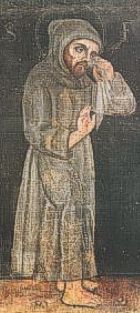
 San Francesco d'Assisi
Lest anyone panic, my homily this morning was a much shorter version of this rather long reflection on today's readings. It timed out at about 7 or 8 minutes. I came home and intended to tighten it up a bit before filing it, but it kept flowing. There must be something God wants to say to somebody reading this. Deo gratias!
Readings: 1 Cor 3,6b-15; Ps 145, 17-21; Lk 6,1-5
We continue this morning with our reading through St. Paul's first letter to the Corinthians. Despite appearances, Paul is still discussing what it means to be spiritual people, albeit it in a sarcastic, but loving manner. In this passage he uses the famous phrase "fools for Christ" (1 Cor 4,10), which many of us associate with St. Francis of Assisi and his early followers, to describe himself and his companion Apollos, as well as all of the apostles. He contrasts the foolishness of the apostles with the Corinthian Christians who, he sarcastically writes, "are wise in Christ" (1 Cor 4,10).
In describing himself and his fellow apostles as "fools for Christ" who are worthy of imitation, Paul writes about what it means to be a fool for Christ. In doing so he is careful not to go beyond what is written, which is just another way of saying that he and Apollos only teach what Christ himself taught. The behaviors Paul attributes to these "fools for Christ" are indeed rooted in Jesus' teachings, particularly in the beatitudes . According to the apostle, a fool for Christ when ridiculed blesses; when persecuted, patiently endures; when slandered, responds gently (1 Cor 4,12-13). This blends in nicely with the reading for this morning's prayer in the Liturgy of the Hours, taken from Romans, chapter 12, in which Paul exhorts the Roman Christians to "Bless those who persecute you; bless and do not curse them. Rejoice with those who rejoice, weep with those who weep. Live in harmony with one another; do not be haughty, but associate with the lowly; do not claim to be wiser than you are. Do not repay anyone evil for evil."
It is easy to see why the world finds such behavior foolish. Certainly each of us individually can attest to the wisdom of God being foolish to those living "in the flesh" by considering our own reactions when we are ridiculed, persecuted, or slandered. We want to defend and justify ourselves. Almost reflexively do we return evil for evil. Such reactions are very natural, which is to say they are visceral and automatic, but we are not slaves to our fallen nature because, as we read in first Corinthians at the beginning of the week, we have received the Spirit of God (1 Cor 2,12). As disciples of the Lord Jesus, empowered by the Holy Spirit, we are called and committed to a higher way, to cooperating with God's grace, which builds on our nature, to being transformed and matured into Christlikeness.
So, when Paul refers to the Corinthians as "kings" and as being "wise" he is lovingly, if sarcastically, chiding them in order to make his point, calling them, and us, to deeper conversion. That to be like Christ is to be accounted a fool is made clear from the very first chapter of this letter:
"The message of the cross is foolishness to those who are perishing, but to us who are being saved it is the power of God. For it is written: 'I will destroy the wisdom of the wise, and the learning of the learned I will set aside." Where is the wise one? Where is the scribe? Where is the debater of this age? Has not God made the wisdom of the world foolish? For since in the wisdom of God the world did not come to know God through wisdom, it was the will of God through the foolishness of the proclamation to save those who have faith'" (1 Cor 1,18-21).
In our passage today, Paul is elaborating even further on this theme. To be wise in Christ, he insists, means to receive in faith what is taught by Christ himself and by his "fools." According to the apostle, the wise person realizes that what s/he possesses is a gift freely given. But a gift is not a gift until it is received. Because what we have received from God, our loving Father, is a freely given gift, not something we earn or deserve, it is not something to be puffed up or haughty about. On the contrary, it should be humbling. After all, who are we that we deserve to be given the riches of God? On receiving God's gift, theologian Hans Urs von Balthasar wrote:
"Faith is a movement of the entire person away from himself, through the gift of grace; thereby he lays hold of the mercy of God given to him in Christ--in the form of the forgiveness of sins, justification, and sanctification. In this movement away from himself man has done all that he, through grace, can do; he has done all that God requires of him. Since his intention is to leave himself, without reservation, and hand himself over entirely, this movement implicitly contains all the 'works' that he will eventually do. They are not some second entity beside faith; if they are performed in a Christian spirit, they are only forms in which faith expresses itself."
Balthasar indicates by his allusion to "all the 'works' that [we] will eventually do, that faith, although a gift from God, is a way of life. Christ himself is "the Way" (Jn 14,6). Even before being known as Christians, followers of Jesus, the movement we now call Christianity, was simply known as "the Way" (Acts 9,2). Paul tells us in his letter to the Romans that the Way must be learned: "Everyone who calls on the name of the Lord shall be saved." But how are they to call on one in whom they have not believed? And how are they to believe in one of whom they have never heard? And how are they to hear without someone to proclaim him? " In this way faith becomes a verb, not a noun.
In addition to sending His beloved Son, God, our Father, sends others who teach us the faith, not just by their words, but more powerfully by their manner of life- those who walk the walk. These are the people, the women and men, we must seek to be like insofar as they are like Christ. Of course, exemplars of the Gospel par excellance are the saints. For our communion extends beyond this world into eternity. The saints are powerful intercessors on our behalf, if we will invoke them. Yesterday, on the Feast of the Nativity of the Blessed Virgin Mary, we discussed briefly three dimensions of our life of worship and devotion: latria, hyper-dulia, dulia. It is the last of these that is the theological term for the veneration, honor, and respect we pay to the saints. I daresay we all have a patron saint, baptismal patron, a confirmation patron, or a saint whose intercession has been beneficial to us. Invoke them daily, ask them to intercede for you, study their lives. By not doing so you forfeit much treasure lavished on us by God, who, as our loving Father, wishes to give us all He has and is.
In today's Gospel Jesus speaks powerfully to the manner of Christian life by his violation of Jewish Sabbath observance. By invoking the example of David and his men eating the bread of offering, reserved for the priests, in their hunger, our Lord tells us that, at root, following Him is not about keepingthe rules. Our Holy Father further highlights this teaching in his encyclical Deus Caritas Est , by writing, "Being Christian is not the result of an ethical choice or a lofty idea, but the encounter with an event, a person, which gives life a new horizon and a decisive direction" (DCE, 1). Those we seek to emulate, the holy women and men both past and present, are those who have encountered our resurrected and living Lord, Jesus Christ. This encounter has given their lives a new and "decisive direction." By decisively turning (to turn around, or change one's mind is the meaning of the Greek word metanoia, usually translated in English Bibles as "repent") in this direction, they chose the narrow path that led to them into beatitude, from whence they can intercede for us.
It is not too much to say that many of us have encountered our resurrected Lord. So, let us ask ourselves, as we prepare to encounter Jesus in the most intimate way in the Eucharist, what difference is our encounter making in our lives today? Let us probe a bit deeper and ask what difference should our encounter with the living Christ be making in our lives? Am I sharing the gift I have been graciously given, or am I prideful and puffed up about it? Does the gift of Jesus Christ make us humble and cause us to give thanks, which is the meaning of Eucharist, always to the Father for having found the Pearl of Great of Price?
It is by asking ourselves these questions frequently and answering them honestly before God both in our private prayer and in our sacramental encounter with Christ in confession that we heed what our Lord and his apostle, St. Paul, teach us. So, on this day as we prepare to celebrate that little Easter we call Sunday, may we be more open to receiving more of the infinite gift that our loving Father wants so desperately to give us- His love, which is His very self. Christ invites us today into his foolishness of which Michael Card sings so beautifully:
We continue this morning with our reading through St. Paul's first letter to the Corinthians. Despite appearances, Paul is still discussing what it means to be spiritual people, albeit it in a sarcastic, but loving manner. In this passage he uses the famous phrase "fools for Christ" (1 Cor 4,10), which many of us associate with St. Francis of Assisi and his early followers, to describe himself and his companion Apollos, as well as all of the apostles. He contrasts the foolishness of the apostles with the Corinthian Christians who, he sarcastically writes, "are wise in Christ" (1 Cor 4,10).
In describing himself and his fellow apostles as "fools for Christ" who are worthy of imitation, Paul writes about what it means to be a fool for Christ. In doing so he is careful not to go beyond what is written, which is just another way of saying that he and Apollos only teach what Christ himself taught. The behaviors Paul attributes to these "fools for Christ" are indeed rooted in Jesus' teachings, particularly in the beatitudes . According to the apostle, a fool for Christ when ridiculed blesses; when persecuted, patiently endures; when slandered, responds gently (1 Cor 4,12-13). This blends in nicely with the reading for this morning's prayer in the Liturgy of the Hours, taken from Romans, chapter 12, in which Paul exhorts the Roman Christians to "Bless those who persecute you; bless and do not curse them. Rejoice with those who rejoice, weep with those who weep. Live in harmony with one another; do not be haughty, but associate with the lowly; do not claim to be wiser than you are. Do not repay anyone evil for evil."
It is easy to see why the world finds such behavior foolish. Certainly each of us individually can attest to the wisdom of God being foolish to those living "in the flesh" by considering our own reactions when we are ridiculed, persecuted, or slandered. We want to defend and justify ourselves. Almost reflexively do we return evil for evil. Such reactions are very natural, which is to say they are visceral and automatic, but we are not slaves to our fallen nature because, as we read in first Corinthians at the beginning of the week, we have received the Spirit of God (1 Cor 2,12). As disciples of the Lord Jesus, empowered by the Holy Spirit, we are called and committed to a higher way, to cooperating with God's grace, which builds on our nature, to being transformed and matured into Christlikeness.
So, when Paul refers to the Corinthians as "kings" and as being "wise" he is lovingly, if sarcastically, chiding them in order to make his point, calling them, and us, to deeper conversion. That to be like Christ is to be accounted a fool is made clear from the very first chapter of this letter:
"The message of the cross is foolishness to those who are perishing, but to us who are being saved it is the power of God. For it is written: 'I will destroy the wisdom of the wise, and the learning of the learned I will set aside." Where is the wise one? Where is the scribe? Where is the debater of this age? Has not God made the wisdom of the world foolish? For since in the wisdom of God the world did not come to know God through wisdom, it was the will of God through the foolishness of the proclamation to save those who have faith'" (1 Cor 1,18-21).
In our passage today, Paul is elaborating even further on this theme. To be wise in Christ, he insists, means to receive in faith what is taught by Christ himself and by his "fools." According to the apostle, the wise person realizes that what s/he possesses is a gift freely given. But a gift is not a gift until it is received. Because what we have received from God, our loving Father, is a freely given gift, not something we earn or deserve, it is not something to be puffed up or haughty about. On the contrary, it should be humbling. After all, who are we that we deserve to be given the riches of God? On receiving God's gift, theologian Hans Urs von Balthasar wrote:
"Faith is a movement of the entire person away from himself, through the gift of grace; thereby he lays hold of the mercy of God given to him in Christ--in the form of the forgiveness of sins, justification, and sanctification. In this movement away from himself man has done all that he, through grace, can do; he has done all that God requires of him. Since his intention is to leave himself, without reservation, and hand himself over entirely, this movement implicitly contains all the 'works' that he will eventually do. They are not some second entity beside faith; if they are performed in a Christian spirit, they are only forms in which faith expresses itself."
Balthasar indicates by his allusion to "all the 'works' that [we] will eventually do, that faith, although a gift from God, is a way of life. Christ himself is "the Way" (Jn 14,6). Even before being known as Christians, followers of Jesus, the movement we now call Christianity, was simply known as "the Way" (Acts 9,2). Paul tells us in his letter to the Romans that the Way must be learned: "Everyone who calls on the name of the Lord shall be saved." But how are they to call on one in whom they have not believed? And how are they to believe in one of whom they have never heard? And how are they to hear without someone to proclaim him? " In this way faith becomes a verb, not a noun.
In addition to sending His beloved Son, God, our Father, sends others who teach us the faith, not just by their words, but more powerfully by their manner of life- those who walk the walk. These are the people, the women and men, we must seek to be like insofar as they are like Christ. Of course, exemplars of the Gospel par excellance are the saints. For our communion extends beyond this world into eternity. The saints are powerful intercessors on our behalf, if we will invoke them. Yesterday, on the Feast of the Nativity of the Blessed Virgin Mary, we discussed briefly three dimensions of our life of worship and devotion: latria, hyper-dulia, dulia. It is the last of these that is the theological term for the veneration, honor, and respect we pay to the saints. I daresay we all have a patron saint, baptismal patron, a confirmation patron, or a saint whose intercession has been beneficial to us. Invoke them daily, ask them to intercede for you, study their lives. By not doing so you forfeit much treasure lavished on us by God, who, as our loving Father, wishes to give us all He has and is.
In today's Gospel Jesus speaks powerfully to the manner of Christian life by his violation of Jewish Sabbath observance. By invoking the example of David and his men eating the bread of offering, reserved for the priests, in their hunger, our Lord tells us that, at root, following Him is not about keepingthe rules. Our Holy Father further highlights this teaching in his encyclical Deus Caritas Est , by writing, "Being Christian is not the result of an ethical choice or a lofty idea, but the encounter with an event, a person, which gives life a new horizon and a decisive direction" (DCE, 1). Those we seek to emulate, the holy women and men both past and present, are those who have encountered our resurrected and living Lord, Jesus Christ. This encounter has given their lives a new and "decisive direction." By decisively turning (to turn around, or change one's mind is the meaning of the Greek word metanoia, usually translated in English Bibles as "repent") in this direction, they chose the narrow path that led to them into beatitude, from whence they can intercede for us.
It is not too much to say that many of us have encountered our resurrected Lord. So, let us ask ourselves, as we prepare to encounter Jesus in the most intimate way in the Eucharist, what difference is our encounter making in our lives today? Let us probe a bit deeper and ask what difference should our encounter with the living Christ be making in our lives? Am I sharing the gift I have been graciously given, or am I prideful and puffed up about it? Does the gift of Jesus Christ make us humble and cause us to give thanks, which is the meaning of Eucharist, always to the Father for having found the Pearl of Great of Price?
It is by asking ourselves these questions frequently and answering them honestly before God both in our private prayer and in our sacramental encounter with Christ in confession that we heed what our Lord and his apostle, St. Paul, teach us. So, on this day as we prepare to celebrate that little Easter we call Sunday, may we be more open to receiving more of the infinite gift that our loving Father wants so desperately to give us- His love, which is His very self. Christ invites us today into his foolishness of which Michael Card sings so beautifully:
"When we in our foolishness thought we were wise/
He played the fool and He opened our eyes/
When we in our weakness believed we were strong/
He became helpless to show we were wrong/
And so we follow God's own fool/
For the only the foolish can tell/
Believe the unbelievable/
And come be a fool as well"