"Hello? Is there anybody in there? Just nod if you can hear me. Is there anyone at home?"
(Roger Waters & David Gimour)
Many words, no responses. More soon, stay tuned (he wrote to nobody).
Wednesday, August 9, 2006


Sunday, August 6, 2006
The Feast of the Transfiguration of the Lord
Altar of Transfiguration painting by Raphael, 1520
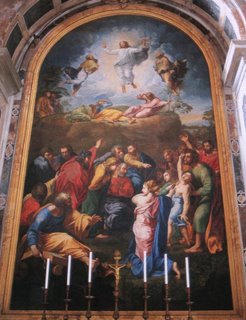
Today we celebrate the Transfiguration of the Lord. A hot, sunny August day when colors are all a bit white, faded by the heat of the sun's ray in summertime, is a great setting for this feast (at least for those of us in the Northern hemisphere). It is, therefore, worthwhile for a little scriptural reflection/comparison/exegesis on the Gospel texts. To that end, I want to briefly compare this pericope as it appears in the Gospels of Matthew and Mark.
Like all synoptic parallel passages, Matthew and Mark share the same outline and structure. In both of these accounts the event takes place six days after Jesus' first prediction of his passion. On this day Jesus takes Peter, James, and John, who, the author of Matthew tells us is James' brother, "up a high mountain." It is on the mountain that "he [Jesus] is transfigured before them." Both authors describe a change in our Lord's appearance. Mark describes only the dazzling whiteness of his clothes, while Matthew, in addition to describing his clothes, also writes: "his face shone like the sun." In both accounts the disciples, while beholding Jesus' glowing transformation, also see Moses and the prophet Elijah "talking" with him.
Upon seeing this, Peter, in both versions, proposes building three "dwellings" on the mountain: one for Jesus, one for Moses, and one for Elijah. In both narratives a cloud overshadows the disciples and a voice from the cloud speaks. The voice identifies Jesus as "my Son" as well as "the Beloved." Peter, James, and John are given the emphatic directive "listen to him!" In Matthew's telling the voice also says it is "well pleased" with the Beloved, the Son.
It is in the responses of the disciples to the transfiguration that significant differences begin to emerge between these two tellings. In Mark's account Peter is "terrified" by what he witnesses. He seems to make his suggestion about erecting the dwellings because, as the author of Mark writes, "He did not know what [else?] to say." This would make Peter's suggestion far less pious than that of Matthew's awestruck Peter.
The reactions of the disciples to the cloud experience also interestingly differ. In Matthew's story, after hearing the voice, the disciples "fell to the ground and were overcome by fear." Jesus tells them to "get up" and "not to be afraid." By contrast, the story found in the Gospel of Mark, after hearing the voice, the three "looked around" and "saw no one with them anymore, but only Jesus." Subtle differences can also be seen as Jesus and the three disciples walk down the mountain. In both accounts Peter, James, and John are "ordered" by Jesus to tell nobody what has occurred until after his death and resurrection. Mark's disciples, despite the preceding prediction of the passion, are left "questioning what the rising from the dead could mean." Compare that to the understanding reception of Jesus' words by Matthew's three. They seem to know what Jesus is talking about, even before the issue of the return of Elijah preceding the advent of the Messiah is raised. From Jesus' answer to the query they comprehend that John the Baptist is Elijah and so what had been revealed on the road to Caesarea-Phillipi is only reaffirmed. Summarily, the differences between the two accounts is that Mark's features much more human disciples and a less wordy, less regal, and, hence, more human Jesus.

Today we celebrate the Transfiguration of the Lord. A hot, sunny August day when colors are all a bit white, faded by the heat of the sun's ray in summertime, is a great setting for this feast (at least for those of us in the Northern hemisphere). It is, therefore, worthwhile for a little scriptural reflection/comparison/exegesis on the Gospel texts. To that end, I want to briefly compare this pericope as it appears in the Gospels of Matthew and Mark.
Like all synoptic parallel passages, Matthew and Mark share the same outline and structure. In both of these accounts the event takes place six days after Jesus' first prediction of his passion. On this day Jesus takes Peter, James, and John, who, the author of Matthew tells us is James' brother, "up a high mountain." It is on the mountain that "he [Jesus] is transfigured before them." Both authors describe a change in our Lord's appearance. Mark describes only the dazzling whiteness of his clothes, while Matthew, in addition to describing his clothes, also writes: "his face shone like the sun." In both accounts the disciples, while beholding Jesus' glowing transformation, also see Moses and the prophet Elijah "talking" with him.
Upon seeing this, Peter, in both versions, proposes building three "dwellings" on the mountain: one for Jesus, one for Moses, and one for Elijah. In both narratives a cloud overshadows the disciples and a voice from the cloud speaks. The voice identifies Jesus as "my Son" as well as "the Beloved." Peter, James, and John are given the emphatic directive "listen to him!" In Matthew's telling the voice also says it is "well pleased" with the Beloved, the Son.
It is in the responses of the disciples to the transfiguration that significant differences begin to emerge between these two tellings. In Mark's account Peter is "terrified" by what he witnesses. He seems to make his suggestion about erecting the dwellings because, as the author of Mark writes, "He did not know what [else?] to say." This would make Peter's suggestion far less pious than that of Matthew's awestruck Peter.
The reactions of the disciples to the cloud experience also interestingly differ. In Matthew's story, after hearing the voice, the disciples "fell to the ground and were overcome by fear." Jesus tells them to "get up" and "not to be afraid." By contrast, the story found in the Gospel of Mark, after hearing the voice, the three "looked around" and "saw no one with them anymore, but only Jesus." Subtle differences can also be seen as Jesus and the three disciples walk down the mountain. In both accounts Peter, James, and John are "ordered" by Jesus to tell nobody what has occurred until after his death and resurrection. Mark's disciples, despite the preceding prediction of the passion, are left "questioning what the rising from the dead could mean." Compare that to the understanding reception of Jesus' words by Matthew's three. They seem to know what Jesus is talking about, even before the issue of the return of Elijah preceding the advent of the Messiah is raised. From Jesus' answer to the query they comprehend that John the Baptist is Elijah and so what had been revealed on the road to Caesarea-Phillipi is only reaffirmed. Summarily, the differences between the two accounts is that Mark's features much more human disciples and a less wordy, less regal, and, hence, more human Jesus.
Saturday, August 5, 2006
Praise for God's Loving Compassion
It is a beautiful morning here along the Western foothills of the Wasatch Front. As I contemplate all that needs to be done today, especially in our yard, I first, along with St. Paul, "affirm that . . . the Gentile peoples are to praise God because of his mercy" (Rom 15,8-9). God's mercy is Jesus Christ, through whom, Paul writes elsewhere in Romans, we are grafted into God's Holy People.
Psalm 117, the shortest Psalm of them all, from Lauds this morning, is how this Gentile chooses to praise God this day:
1 Praise the LORD, all you nations! Give glory, all you peoples!
2 The LORD'S love for us is strong; the LORD is faithful forever. Hallelujah!
Write this prayer on your heart today and recite as you go about your activities, especially your chores. In this way you'll heed St. Paul's exhortation to "Pray without ceasing". Utter a prayer or two for the peace of Israel and throughout the world. God offers us His peace, Jesus Christ.
Psalm 117, the shortest Psalm of them all, from Lauds this morning, is how this Gentile chooses to praise God this day:
1 Praise the LORD, all you nations! Give glory, all you peoples!
2 The LORD'S love for us is strong; the LORD is faithful forever. Hallelujah!
Write this prayer on your heart today and recite as you go about your activities, especially your chores. In this way you'll heed St. Paul's exhortation to "Pray without ceasing". Utter a prayer or two for the peace of Israel and throughout the world. God offers us His peace, Jesus Christ.
Friday, August 4, 2006
St. Peter's Basilica
I have to add my hearty endorsement to the many that have already been published to R.A. Scotti's book on the history of St. Peter's entitled Basilica. It is a masterfully written history of Christendom's main church from its conception by Nicholas V to its dedication. It is not a thorough history and there are a few minor errors, detectable only by those who really know Rome and/or Roman history. But her chronology is correct as are her portraits of the main characters in this drama- Julius II, Michangelo, Raphael, and some of the unsung players without whom we would either have no basilica, or one not nearly as grand. It is also a well-written, popular book on the Renaissance and the transition from the Renaissance to the Counter-Reformation. While a Catholic book through-and-through, Scotti does a decent job of discussing the corruption of the Renaissance Church, the sources of her corruption, and attempts at Reform, such as Luther's, which one in particular was due in no small part to his visit to Rome and the trafficking in indulgences to pay for the construction of St. Peter's Basilica. This book, along with James Martin, S.J.'s My Life With The Saints are two of the best popular books I have read this year.
Pray for the Peace of Jerusalem
Honoring the day our Lord was crucified for the sins of the world, for our own sins, and to reconcile a broken creation to God's infinite holiness, Fridays are, traditionally for Catholics, days of abstinence, penance, and prayer. Penance flows, as Hebrews 6,6 hints, from the realization that we are guilty of blood of Christ; that our sins nailed Him to the Cross. Eamon Duffy, eminent Church historian, wrote an article a few years back in The Tablet on fasting and abstinence that critically asks, Why is Friday no longer a day of fasting and abstinence?
So, in a spirit of penance let us pray for peace throughout the world, for justice and security for all peoples, for the peace of Israel. Might I recommend praying in particular Psalm 130 and Psalm 83. Asking Christians to pray Psalm 83 may seem a bit odd, as it calls up God to wipe out the enemies of Israel. But, whether God changes the hearts of those attacking Israel, or allows Israel to defend itself we can leave to God. It is important to note that militant Islam, of the kind espoused by Hebollah, is an enemy of Christianity, too. Militant Islam has been disastrous for Palestinian Christians and Arabic Christians throughout the Middle East, either forcing conversions or emigration. Let's call not mince words, unprovoked attacks, especially on exclusively civilian targets, is evil. We should pray for an end such evil.
So, in a spirit of penance let us pray for peace throughout the world, for justice and security for all peoples, for the peace of Israel. Might I recommend praying in particular Psalm 130 and Psalm 83. Asking Christians to pray Psalm 83 may seem a bit odd, as it calls up God to wipe out the enemies of Israel. But, whether God changes the hearts of those attacking Israel, or allows Israel to defend itself we can leave to God. It is important to note that militant Islam, of the kind espoused by Hebollah, is an enemy of Christianity, too. Militant Islam has been disastrous for Palestinian Christians and Arabic Christians throughout the Middle East, either forcing conversions or emigration. Let's call not mince words, unprovoked attacks, especially on exclusively civilian targets, is evil. We should pray for an end such evil.
Thursday, August 3, 2006
Year B 7th Sunday in Ordinary Time
Readings: Isa 43,18-19.21-22, 24b-25; Ps 41,2-5. 13-14; 2 Cor 1,18-22; Mk 2,1-12
Introduction
Today’s readings give us an opportunity to look forward to Lent by drawing our attention to the need each one of us has to be forgiven. Our attention is drawn to the sacraments in general and to the sacrament of reconciliation in particular. For the sacraments truly constitute the economy of salvation. If the sacraments are so important for our salvation, it follows that the Church, our Holy Mother, from whom we receive divine nourishment, is also necessary to attain the end for which we are created.
The Church in the economy of salvation
The Church is a hierarchy. A hierarchy is not, as some would have us believe, an oppressive, patriarchal order. At its most basic, it is a sacred ordering. Our Holy Father, in his homily on the occasion of his installation as Bishop of Rome, said regarding hierarchy: “Presiding in doctrine and presiding in love must . . . be one and the same: the whole of the Church's teaching leads ultimately to love.” Love, therefore, “is the criterion for all teaching” (Benedict Installation Homily- 7 May 2005)
To this end, theologian Hans urs von Balthasar, observes: “the entire structure of the Church, from the Petrine ministry to humblest parish pastorate, exists for one purpose: making saints.” “The ultimate reason for her whole institutional structure and objective side,” writes Balthasar, is “the obligatory vocation to subjective and personal sanctity” (The Saints of John Paul II by Philip Zaleski in First Things #161). This universal call to holiness is seen even more clearly in the document Lumen Gentium, written and promulgated during the Second Vatican Council. Referring to the sacraments, the Council Fathers write: “Fortified by . . . such powerful means of salvation, all the faithful, whatever their condition or state, are called by the Lord, each in his own way, to that perfect holiness to that perfect holiness whereby the Father Himself is perfect” (LG 11). It also must be noted that the Church herself is "the universal sacrament of salvation" (Gaudium et Spes 45). Holiness, as each of us knows from our own experience, is not a state we can achieve through our own efforts. Hence, we pray with the psalmist, “Lord, heal my soul, for I have sinned against you” (Ps 41,5). We need God’s help to attain holiness. The name for this undeserved help is grace.
The Sacraments in the economy of salvation
That it is the hallmark of our divine and catholic faith that the sacraments are the means God uses to communicate grace to us is beyond dispute. However, by holding this we do not restrict God, for the Spirit blows where it will (Jn 3,8) The sacraments are sure means of receiving what God so desperately wants to give us. So, rather than have to exercise subjective and uncertain judgment about where and how God is working, the sacraments give us certainty.
At its most basic the economy of salvation is the ordinary and objective way God sanctifies us. In today’s second reading Paul is forced to defend his apostolic ministry. He makes his defense in a way that aids us in understanding the economy of salvation. In this passage, Paul uses commercial images to describe how the Holy Spirit works in the lives of believers. The seals that are affixed to merchandise signify ownership and identity- like designer labels on clothing today. The seal of the Spirit functions the same. It marks us as belonging to God. The seal of the Spirit also acts as a pledge of deposit, a guarantee of future blessings. The sacraments, especially baptism, and confirmation are what mark us by placing the seal of the Spirit on us, as well as being a deposit on the future blessing of life eternal.
The Sacrament of Reconciliation in the sacramental economy
We come now to the main point of today’s readings, which aids us in preparing for the holy season of Lent. This instruction also informs us of the roles confession and reconciliation play in the sacramental economy. In order to receive the graces God gives us in and through the sacraments, we must receive the sacraments worthily. In other words, we should be in a state of grace when receiving the sacraments, especially eucharist- the sacrament of sacraments- of which, St. Paul writes, one “should examine himself first; only then should he eat of the bread and drink of the cup . . ." (1 Cor 11, 28). The exceptions to this are, of course, the sacraments of baptism and reconciliation.
We are baptized only once. It is, therefore, through confession of our sins in the sacrament of reconciliation that we receive God’s forgiveness for sins committed after baptism. In this sacrament we realize what Isaiah writes about in our first reading. In this passage Isaiah writes powerfully of the regeneration that God effects. Rivers flow in the desert, bringing life to an otherwise fairly lifeless place. God brings water “to give drink to [his] chosen people” (Isa 43,20). The water of which Isaiah writes is a metaphor for God’s mercy and forgiveness. God wants to do something new in each of our lives. To this end, he provides a way to wipe out our sins and to remember them no more (Isa 43,25), thus giving us a new start.
Sin is a concrete reality and one Jesus calls us to confront in an honest and forthright way, as he does so boldly and unexpectedly in today’s Gospel. We kill the divine, Trinitarian life God shares with us by our deliberate failure to keep the promises each of us made at our baptism, in which we “reject sin so as to live in the freedom of God’s children.”
In our readings from Mark’s Gospel over the past several Sundays we have read about Jesus healing the sick and casting out demons. In today’s Gospel we have something like a convergence of these two aspects of Jesus’ ministry when he first forgives the sins of the paralytic man, dispelling the evil he is plagued by, and only then curing his paralysis, which, it is important to note, is not caused by his sinfulness. Let us also note the eagerness of the man to receive what only Jesus Christ can give him.
Oh, my dear friends, that we should be so eager to receive the peace and joy found in the sacrament of reconciliation! By first saying, “Child, your sins are forgiven” (Mk 2,5), Jesus sees the man’s need for forgiveness as a more urgent need than the curing of his paralysis. Indeed, the greatest disability, the most debilitating disease from which we can suffer is sin.
In this currently neglected, but nonetheless necessary, sacrament, sanctifying grace, which is lost through sin, is restored. In confession the priest acts in the person of Christ by absolving our sins. This is done on the same authority that Jesus forgives the paralytic man. Christ, by virtue of his divinity, is this authority. He, in turn, gave it to his apostles, from whom it is handed on, literally, by the conferral of the sacrament of holy orders when a man is ordained a priest.
Lest anyone think this is an outdated, outmoded, or no longer necessary way of understanding how God chooses to share and restore divine life within us, let us turn again to Vatican II’s Lumen Gentium: “Those who approach the sacrament of Penance obtain pardon from the mercy of God for the offence committed against Him and are at the same time reconciled with the Church, which they have wounded by their sins, and which by charity, example, and prayer seeks their conversion” (LG 11).
Conclusion
If anyone believes in Jesus Christ and yet struggles with the necessity of confession, let him/her answer the question posed by Jesus today: “Which is easier to say, ‘Your sins are forgiven,” or to say, ‘Rise, pick up your mat and walk’” ((Mk 2,11)? In answering the question keep in mind that it was only because of the hardness of the hearts of those who refused to believe that he caused the man to walk, but it was out of divine love and mercy that Jesus forgave his sins. As to how God’s power is made most manifest, consider what the late Christian songwriter, Rich Mullins sang: “It took the hand of almighty God to part the waters of the sea, but it only took one little lie to separate you and me." My friends, we are not as strong or self-sufficient as we often think we are (Rich Mullins, We Are not as Strong as We Think We Are).
Introduction
Today’s readings give us an opportunity to look forward to Lent by drawing our attention to the need each one of us has to be forgiven. Our attention is drawn to the sacraments in general and to the sacrament of reconciliation in particular. For the sacraments truly constitute the economy of salvation. If the sacraments are so important for our salvation, it follows that the Church, our Holy Mother, from whom we receive divine nourishment, is also necessary to attain the end for which we are created.
The Church in the economy of salvation
The Church is a hierarchy. A hierarchy is not, as some would have us believe, an oppressive, patriarchal order. At its most basic, it is a sacred ordering. Our Holy Father, in his homily on the occasion of his installation as Bishop of Rome, said regarding hierarchy: “Presiding in doctrine and presiding in love must . . . be one and the same: the whole of the Church's teaching leads ultimately to love.” Love, therefore, “is the criterion for all teaching” (Benedict Installation Homily- 7 May 2005)
To this end, theologian Hans urs von Balthasar, observes: “the entire structure of the Church, from the Petrine ministry to humblest parish pastorate, exists for one purpose: making saints.” “The ultimate reason for her whole institutional structure and objective side,” writes Balthasar, is “the obligatory vocation to subjective and personal sanctity” (The Saints of John Paul II by Philip Zaleski in First Things #161). This universal call to holiness is seen even more clearly in the document Lumen Gentium, written and promulgated during the Second Vatican Council. Referring to the sacraments, the Council Fathers write: “Fortified by . . . such powerful means of salvation, all the faithful, whatever their condition or state, are called by the Lord, each in his own way, to that perfect holiness to that perfect holiness whereby the Father Himself is perfect” (LG 11). It also must be noted that the Church herself is "the universal sacrament of salvation" (Gaudium et Spes 45). Holiness, as each of us knows from our own experience, is not a state we can achieve through our own efforts. Hence, we pray with the psalmist, “Lord, heal my soul, for I have sinned against you” (Ps 41,5). We need God’s help to attain holiness. The name for this undeserved help is grace.
The Sacraments in the economy of salvation
That it is the hallmark of our divine and catholic faith that the sacraments are the means God uses to communicate grace to us is beyond dispute. However, by holding this we do not restrict God, for the Spirit blows where it will (Jn 3,8) The sacraments are sure means of receiving what God so desperately wants to give us. So, rather than have to exercise subjective and uncertain judgment about where and how God is working, the sacraments give us certainty.
At its most basic the economy of salvation is the ordinary and objective way God sanctifies us. In today’s second reading Paul is forced to defend his apostolic ministry. He makes his defense in a way that aids us in understanding the economy of salvation. In this passage, Paul uses commercial images to describe how the Holy Spirit works in the lives of believers. The seals that are affixed to merchandise signify ownership and identity- like designer labels on clothing today. The seal of the Spirit functions the same. It marks us as belonging to God. The seal of the Spirit also acts as a pledge of deposit, a guarantee of future blessings. The sacraments, especially baptism, and confirmation are what mark us by placing the seal of the Spirit on us, as well as being a deposit on the future blessing of life eternal.
The Sacrament of Reconciliation in the sacramental economy
We come now to the main point of today’s readings, which aids us in preparing for the holy season of Lent. This instruction also informs us of the roles confession and reconciliation play in the sacramental economy. In order to receive the graces God gives us in and through the sacraments, we must receive the sacraments worthily. In other words, we should be in a state of grace when receiving the sacraments, especially eucharist- the sacrament of sacraments- of which, St. Paul writes, one “should examine himself first; only then should he eat of the bread and drink of the cup . . ." (1 Cor 11, 28). The exceptions to this are, of course, the sacraments of baptism and reconciliation.
We are baptized only once. It is, therefore, through confession of our sins in the sacrament of reconciliation that we receive God’s forgiveness for sins committed after baptism. In this sacrament we realize what Isaiah writes about in our first reading. In this passage Isaiah writes powerfully of the regeneration that God effects. Rivers flow in the desert, bringing life to an otherwise fairly lifeless place. God brings water “to give drink to [his] chosen people” (Isa 43,20). The water of which Isaiah writes is a metaphor for God’s mercy and forgiveness. God wants to do something new in each of our lives. To this end, he provides a way to wipe out our sins and to remember them no more (Isa 43,25), thus giving us a new start.
Sin is a concrete reality and one Jesus calls us to confront in an honest and forthright way, as he does so boldly and unexpectedly in today’s Gospel. We kill the divine, Trinitarian life God shares with us by our deliberate failure to keep the promises each of us made at our baptism, in which we “reject sin so as to live in the freedom of God’s children.”
In our readings from Mark’s Gospel over the past several Sundays we have read about Jesus healing the sick and casting out demons. In today’s Gospel we have something like a convergence of these two aspects of Jesus’ ministry when he first forgives the sins of the paralytic man, dispelling the evil he is plagued by, and only then curing his paralysis, which, it is important to note, is not caused by his sinfulness. Let us also note the eagerness of the man to receive what only Jesus Christ can give him.
Oh, my dear friends, that we should be so eager to receive the peace and joy found in the sacrament of reconciliation! By first saying, “Child, your sins are forgiven” (Mk 2,5), Jesus sees the man’s need for forgiveness as a more urgent need than the curing of his paralysis. Indeed, the greatest disability, the most debilitating disease from which we can suffer is sin.
In this currently neglected, but nonetheless necessary, sacrament, sanctifying grace, which is lost through sin, is restored. In confession the priest acts in the person of Christ by absolving our sins. This is done on the same authority that Jesus forgives the paralytic man. Christ, by virtue of his divinity, is this authority. He, in turn, gave it to his apostles, from whom it is handed on, literally, by the conferral of the sacrament of holy orders when a man is ordained a priest.
Lest anyone think this is an outdated, outmoded, or no longer necessary way of understanding how God chooses to share and restore divine life within us, let us turn again to Vatican II’s Lumen Gentium: “Those who approach the sacrament of Penance obtain pardon from the mercy of God for the offence committed against Him and are at the same time reconciled with the Church, which they have wounded by their sins, and which by charity, example, and prayer seeks their conversion” (LG 11).
Conclusion
If anyone believes in Jesus Christ and yet struggles with the necessity of confession, let him/her answer the question posed by Jesus today: “Which is easier to say, ‘Your sins are forgiven,” or to say, ‘Rise, pick up your mat and walk’” ((Mk 2,11)? In answering the question keep in mind that it was only because of the hardness of the hearts of those who refused to believe that he caused the man to walk, but it was out of divine love and mercy that Jesus forgave his sins. As to how God’s power is made most manifest, consider what the late Christian songwriter, Rich Mullins sang: “It took the hand of almighty God to part the waters of the sea, but it only took one little lie to separate you and me." My friends, we are not as strong or self-sufficient as we often think we are (Rich Mullins, We Are not as Strong as We Think We Are).
St. Mary Magdalene
Here is a link to the article in our local Catholic newspaper, The Intermountian Catholic, on the lecture I gave almost two weeks ago: "St. Mary Magdalene celebrated in music and word." Again, a lot to say and write the Apostle to the Apostles. I will try to get my notes together and publish some of what I said.
Subscribe to:
Posts (Atom)
Feast of the Exaltation of the Holy Cross
Readings: Numbers 21:4b-9; Psalm 78:1-2.34-38; Philippians 2:6-11; John 3:13-17 Today the Church throughout the world celebrates the Feas...

-
It is time to introduce yet another member of my community of the heart. Yesterday I mentioned that the theology of Hans Urs von Balthasar w...
-
Recently I have been asked several times about remarriage and the permanent diaconate. In the present state-of-affairs, which may eventually...
-
 Because my parish celebrated Mass in the evening instead of in the morning today, I was able to assist my pastor at the altar on this Memori...
