Monday, December 11, 2006

Seeing through a glass darkly and discerning the pattern of redemption

English poet Sir John Betjeman, despite his complicated marriage and morally problematic personal life, was a deeply religious person, as were his wife, Penelope, and his mistress Lady Elizabeth Cavendish. In a review of a recent biography on Betjeman by A.N. Wilson, Paul Dean, writing in The New Criterion (registration and subscription req'd), relates this episode in which Betjeman responds to "Roy Herrod's put-down that religion did nothing to solve the world's problems." His reply was that it depends on what one perceives the world's problems to be. As for Betjeman, ' I choose the Christian's way (and completely fail to live up to it) because I believe it is true and because I believe - for possibly a split second in six months, but that's enough - that Christ really is the incarnate Son of God and that Sacraments are means of grace and that grace alone gives one the power to do what one ought to do.'"

To which I can only add, Amen on a snowy Monday morning. I must state up-front that Betjeman was not Catholic, but Anglican. It was to his lasting sorrow that his wife, Penelope neé Chetwode, became a Catholic.

When I read Dean's review Saturday evening, it immediately struck me that this episode was a good follow-up to Philosophy and Theology. It is all the more appropriate as a follow-up because Betjeman: A Life is by Wilson, whose faithful doubting turned into doubts about faith. Several years ago over Christmas I read his very thoughtful and elegiac God's Funeral: A Biography of Faith and Doubt in Western Civilization. However, Wilson's panegyric for God is not a really a survey of faith and doubt in Western civilization. Rather, it is a survey of faith and doubt in Victorian and Edwardian England. The book is no less poignant and thoughtful because it fails to live up to the inflated claims of the subtitle.

Sunday, December 10, 2006

A more functional request

"But I love this blog...I was just telling a friend over dinner that your teaching is what keeps me going back to Mass each Sunday. How could it be ego-gratification when others are learning from your teachings?I'm learning so much more about my faith because of your blog. But not only that, it has led me to other sites which have opened my eyes and mind to the teachings of the Catholic Church. It's through your blog that I found Sacred Space which I visit each day to pray. I guess I'll have to respect your decision, but must say I'm very saddened by the news."


I appreciate these words from Rachel. It is probably more strangeness on my part, but I need to be encouraged a bit from time-to-time, nothing huge, just to know that I am not writing entirely for my own benefit. I am an advocate of journaling, though I have never done it with any consistency. I enjoy writing the blog, I would be less than honest to state otherwise. I have to admit that I often feel like I am sending words into a void. I hope nobody feels like their thoughts on various matters are not worth sharing. Therefore, I'll proceed cautiously. I apologize for not finding a more functional way of expressing my doubts about continuing. I suppose I could have asked for readers to comment with feedback about the blog. So, I am doing that now. Furthermore, I would like to know who makes up this anonymous third person you, the reader.

So, what I am asking is if you read this blog with regularity, please leave a comment. Feel free to write what you want. If you need some ideas, just answer these questions:
1) Let me know you're there, who are you- without a great deal of personal detail
2) Tell me what you like about the blog
3) Tell my what you don't like about the blog, my writing, my tone. etc.
4) Most importantly, feel free to ask questions, to challenge me, to disagree

Do this with the understanding that I am who I am and this blog is a very personal endeavor for me. This does not constitute a straw poll that I will then change to accomodate, but it will give me an idea for whom I am writing, my audience. It will also give me insight to how what I write and how I write it goes over. So, the comment link is open.

Friday, December 8, 2006

Philosophy and Theology

"Does anyone know we're here? Or care? Does faith in God relieve us of the horror of this scene once and for all? Or is this scene inescapable, not because it can be firmly established as the final truth, but because it remains a possibility that haunts and menaces faith like a ghost? And in constantly menacing faith, does this eerie scene in fact help to constitute faith as faith, which does not see in whole but only in part?"

What scene? The scene in question is taken from Friedrich Nietzsche and, as described by philosopher John Caputo, goes as follows:
"Once upon a time, on a little star in a distant corner of the universe, clever little animals invented for themselves proud words, like truth and goodness. But soon enough the little star cooled, and the little animals had to die and with them their proud words. But the universe, never missing a step, drew another breath and moved on, dancing its cosmic dance across endless skies".

The cluster of questions brought up by Nietzsche's parable, is, for Caputo "the way the issues of philosophy and theology get raised". Indeed, the two overlap, intertwine and communicate with each other in what is described as "kind of endless contest". Therefore, "philosophers and theologians go for the 'ultimates,' the deepest questions," the questions "that keep imposing themselves on us". This makes philosophers and theologians "slightly unstable types, people who have been knocked off their pins by such questions, who have been drawn into an exploration of the outer and inner space of our lives".

All of this is from the introduction to a wonderful little book (all of 74 pages) by Caputo, part of Abingdon Press' Horizons in Theology series, and entitled Philosophy and Theology. Caputo has made a tremendous contribution to contemporary philosophy and theology through his work on the significance and relevance of post-modern philosophy to theology through such works as Heidegger and Aquinas: An Essay on Overcoming Metaphysics and The Prayers and Tears of Jacques Derrida: Religion Without Religion.

In distinguishing the theology from philosophy, Caputo contends that "theologians belong to communities of faith, and their work is to think through the 'tenets of faith' or the 'contents of revelation,' both the words of the Scriptures and the common faith passed down by the faithful over the ages". One way to define theology, then, "is the place where the community of faith does its thinking, examining, clarifyng, conceptualizing, and updating the common faith over the course of its history". Whereas philosophers, typically, think of themselves as being independent, freelance thinkers- though few are as independent and they think themselves to be . Indeed, theology cannot be done apart from a faith community. Therefore, ecclesial theologian is, in Kantian terms, an analytic statement because the predicate is contained in the concept of the subject. In other words, there is no value added to theologian by appending ecclesial as a descriptor. Anyway, Caputo's book is a great introduction to this relationship. It would be a great textbook. I learned of the book from Fr. Edward Oakes, SJ last summer, acquired a copy and I am just now getting around to reading it.

Feast of the Immaculate Conception

Today is a Holy Day of Obligation, a day that we are to observe, as closely as possible, as a Sunday. We are obligated to attend Mass. Do not panic, most parishes have an evening liturgy, call and go! I must note that today is not a celebration of the Blessed Virgin's conception of our Lord. That feast is Annunciation, which we celebrate 25 March, nine months before Jesus' Nativity. Our Blessed Mother's Immaculate Conception, made known most especially in Her apparitions to St. Benadette Soubrious, was dogmatically defined by Pope Pius IX 8 December 1854 in the Apostolic Constitution Ineffabilis Deus. The formal definition begins as follows:

"Wherefore, in humility and fasting, we unceasingly offered our private prayers as well as the public prayers of the Church to God the Father through his Son, that he would deign to direct and strengthen our mind by the power of the Holy Spirit. In like manner did we implore the help of the entire heavenly host as we ardently invoked the Paraclete. Accordingly, by the inspiration of the Holy Spirit, for the honor of the Holy and undivided Trinity, for the glory and adornment of the Virgin Mother of God, for the exaltation of the Catholic Faith, and for the furtherance of the Catholic religion, by the authority of Jesus Christ our Lord, of the Blessed Apostles Peter and Paul, and by our own:

We declare, pronounce, and define that the doctrine which holds that the most Blessed Virgin Mary, in the first instance of her conception, by a singular grace and privilege granted by Almighty God, in view of the merits of Jesus Christ, the Savior of the human race, was preserved free from all stain of original sin, is a doctrine revealed by God and therefore to be believed firmly and constantly by all the faithful. "


Note the Pope Pius IX's reference to fasting and prayer, the beautiful Trinitarian nature of, lacking a better description, how prayer works. It is lovely as befits anything having to do with Immaculate Mary.

"Immaculate Mary, your praises we sing/
You reign now in splendor with Jesus our King/
Ave, ave, ave Maria/
Ave, ave Maria"


Holy Mary, Mother of God- pray for us
Saint Bernadette- pray for us

Thursday, December 7, 2006

Tarcisio Cardinal Bertone Speaks about the Holy Father's Recent Apostolic Journey

I mentioned in a earlier post how hopeless the secular media is in understanding anything the Holy Father does and how it frequently misinterprets the meaning and symbolism of much of what he says and does. To just take one example, CNN's Anderson Cooper 360 entitled their weeklong coverage of the Holy Father's trip, When Faiths Collide: The Pope in Turkey. It is refreshing, therefore, to read what Tarcisio Cardinal Bertone, Vatican Secretary of State, had to say in an interview with Gianni Cardinale, for the newspaper of the Italian Bishops Conference, L'Avvenire. I have to acknowledge my debt to NCR's John Allen for the tip-off that this interview had occurred and for his always insightful commentary.

The first clarification Cardinal Bertone makes has to do with the political dimension of the Holy Father's visit. Saying that he was glad that Turkish Prime Minister, Recep Tayyip Erdogan, decided to meet with the Pope, he also said it would have been strange had he not met with Benedict because it was the Turkish government that wanted the Holy Father's visit to have a political dimension, as the Pope is Vatican head-of-state. From the time he proposed it, Pope Benedict XVI said he wanted his trip to be a spiritual pilgrimage, "without", the Cardinal says, "stopping in the political capital of the country". A visit during which he had to go to Mustafa Kemal Atatürk's mausoleum and sign the "golden book". According to the Secretary of State, it "was the civil authorities who, legitimately, insisted that the trip also have a 'political' dimension." Hence, "it would have been truly strange if those authorities withdrew from meeting with the pope", even after Regensburg. Of course, it would help if they had read and sought to understand the Holy Father's Regensburg lecture. Especially given that the Holy See readily acceded to having the Pope begin his trip in Ankara.

Politicians being politicians throughout the world, PM Erdogan did not miss the opportunity to make the reversal of his decision to meet with the Holy Father work to his advantage, or at least not lose face, by emerging from the airport terminal, at which he met Pope Benedict, and declaring that Pope Benedict XVI, who, as Cardinal Ratzinger, publicly opposed Turkey's admission to the European Union, now supported Turkey's bid. Cardinal Bertone also clarifies this by reiterating what the Holy Father himself told the international media on the flight to Ankara: "As is known, the Holy See does not have an official position on the entry of Turkey or any other country into the European Union". Furthermore, the Holy See doesn't want to possess "any political judgment in this sense". The real point of the Pope's message, the true theme, according to Cardinal Bertone, was religious freedom. "Certainly the Holy See always hopes that the countries which form part of the European Union- all, without exception . . . respect [the] liberty to publicly profess one's own faith," a right "which must be guaranteed to every person and to every religious community". But, even on this score, the Holy Father was sensitive to the input given him by Turkey's Christian communities (Orthodox, Syriac, Armenian, Catholic) prior to his visit. He did not call Turkey, who represses and oppresses its Christian communities in significant ways, out in a way that would cause embarassment or make the situation worse for these communities.

In a refreshingly straightforward statement that reflects his background as a theologian and pastor, not a diplomat, Cardinal Bertone said, on an almost unrelated note, "If I can put it in a sound-bite, the church doesn't really worry about atheists, however devout, because they're out of her spiritual jurisdiction". "Much more worrisome," Cardinal Bertone opined, "are those inside the church who work to distort its faith and moral principles, or who oppose the pope and his design for renewal of the church".

Motivation


"I shall wait for my Lord and Savior and point him out when he is near, alleluia."


(Antiphon for Canticle of Zechariah Morning Prayer, Thursday, First Week of Advent)

Wednesday, December 6, 2006

If a picture is worth a thousand words, a question asked in jest is worth a million serious questions

On last night's Daily Show, former Missouri Senator John Danforth, who is an Episcopal priest and was during his years in the Senate, as well as during his brief tenure as Ambassador to the U.N. between John Negorponte's resignation in order to become U.S. Ambassador to Iraq and President Bush's recess appointment of John Bolton, appeared in promotion of his new book, Faith and Politics: How the "Moral Values" Debate Divides America and How to Move Forward Together. It appears to me, not having read the book, that Senator Danforth takes a largely negative view of religious people, conservatives in particular, bringing their faith and the values derived from their faith to bear on their voting, or, if an elected official, to bear on laws and policies. Apparently, insisting that the state has a vital interest in both safe-guarding human life from conception to natural death and protecting society's building block, the family, is just too divisive.
According to Senator Danforth, it is time for politics to be unifying. Huh? What is democracy, if not the hashing out of different points-of-view? Why should a certain group of people have to check their most deeply held convictions at the entrance to the Public Square? To be fair, it does not seem to me that Danforth wants to ban faith from the Public Square entirely, he just wants to eliminate those whose faith leads them to different conclusions than those to which his faith leads him. Now, that's democracy!
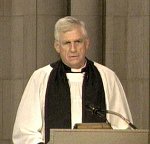
As humor often does, John Stewart arrived, albeit inadvertently, via a humorous question, at a deep insight. Of course, the question was ignored because it was a joke. The question Stewart asked Danforth was, given the views he expresses in his book, "as a U.S. Senator and an Episcopal minister, did you believe in seperation of you from you?" I would be interested in Danforth's response to this question.

Now, lest this post be written off as right-wing rant, in addition to not being a right-winger, let me state three things:
1) The Republican Party has cynically manipulated voters, especially during the Bush presidency. For this they paid the price on 7 November. My point? Democracy works.
2) "Democracy demands," Senator Obama said in speech this past Spring, "that the religiously motivated translate their concerns into universal, rather than religion-specific, values. It requires that their proposals be subject to argument and amenable to reason. I may be opposed to abortion for religious reasons, but if I seek to pass a law banning the practice, I cannot simply point to the teachings of my church or evoke God's will. I have to explain why abortion violates some principle that is accessible to people of all faiths, including those with no faith at all." I would add that even if people of faith fail to translate their concerns into universal values, they are free to bring them to bear when they vote, or when they hold public office. And, if, as public office-holders, their positions represent their constituencies, they can continue to serve.
3) It is also necessary, as Pope Benedict XVI recently observed, for the Church, in her proclamation, to link the two poles, to bridge the gap, between so-called liberal values of peace, care for the environment, and social justice with so-called conservative values of protecting life from conception to natural death, the place and meaning of sexuality, and defense of the family. None of these values are mutually exclusive.

I, for one, do not seperate me from me when voting or advocating. Or, to put it in language fit for congregational proclamation: I believe in personal integration, not compartmentalization.

Tragedy challenges God's love

No sooner did I finish my reflection on this week's second reading from Romans chapter 8 about the all-encompassing nature of God's...